


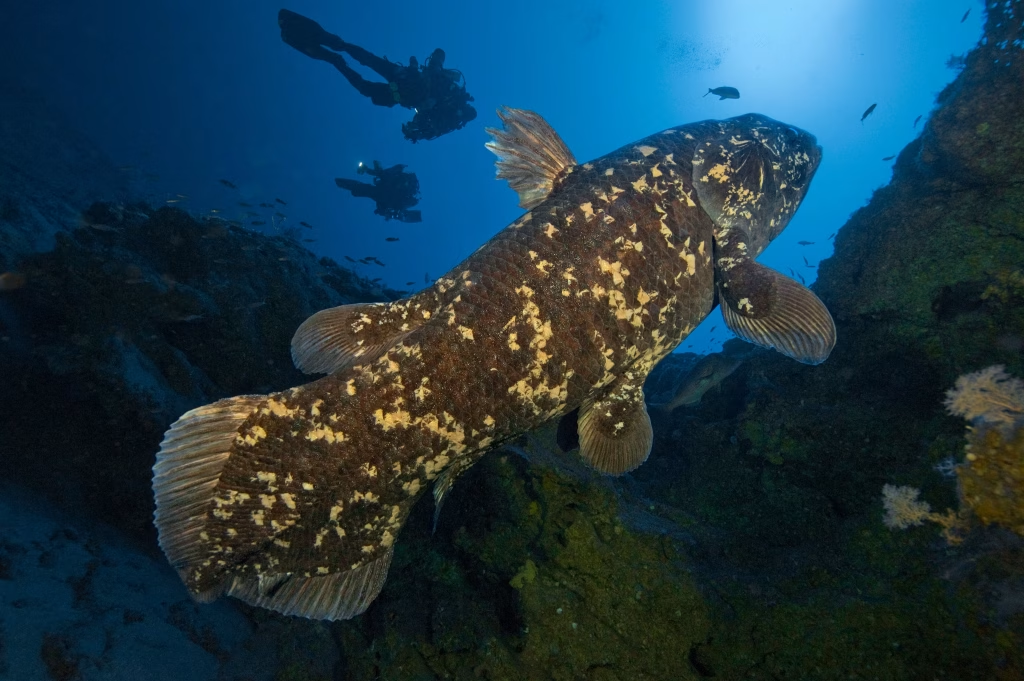
The coelacanth has a name that echoes through the annals of paleontology. This ancient fish holds a unique and captivating position in the history of life on Earth. Scientists once believed it vanished with the dinosaurs over 66 million years ago. The rediscovery of living specimens in the 20th century was astonishing. It transformed this ancient fish into an iconic “living fossil.” These deep-sea dwellers have archaic features and a slow evolutionary pace. They offer an extraordinary window into the distant past. They continue to intrigue scientists seeking to understand the transition from water to land.
A Glimpse into Deep Time
The fossil record reveals that coelacanths first appeared during the Early Devonian period. This was approximately 420 million years ago and long before the rise of dinosaurs. For hundreds of millions of years, they thrived in both marine and freshwater environments. They diversified into a significant group with around 90 known species. Their reign spanned vast geological epochs, witnessing major evolutionary events on the planet. However, the youngest known coelacanth fossils date to the end of the Cretaceous period, leading scientists to conclude that they had succumbed to the catastrophic extinction event that wiped out the non-avian dinosaurs.


The Lazarus Effect: Rediscovery and Revelation
The scientific world was stunned in December 1938. Marjorie Courtenay-Latimer, a museum curator in East London, South Africa, encountered an unusual fish caught by a trawler. This bizarre creature, with its lobed fins and distinctive features, was unlike any modern fish known at the time. Ichthyologist Dr. J.L.B. Smith identified it as a coelacanth, a discovery that sent shockwaves through the scientific community. It was as if a creature from a long-lost world had resurfaced, challenging established notions of extinction. This first living specimen was named Latimeria chalumnae in honor of its discoverer.
The rediscovery ignited a fervent search for more specimens, confirming that coelacanths had indeed survived the Cretaceous extinction. In 1952, researchers found a second living coelacanth in the Comoros Islands, northwest of Madagascar. This discovery established the existence of a viable population. Later, in 1998, scientists found a distinct population near Manado, Sulawesi, Indonesia. It was subsequently described as a new species, Latimeria menadoensis. This species differs slightly in appearance, showing a brown coloration compared to the African species’ metallic blue.


Anatomy of an Ancient Lineage
Coelacanths exhibit a fascinating mosaic of primitive and derived characteristics, reflecting their ancient lineage. Some of their notable anatomical features include:
- Lobed Fins: Perhaps the most distinctive feature, their paired pectoral and pelvic fins have fleshy, limb-like bases supported by bones. These fins move in an alternating pattern, reminiscent of the gait of early tetrapods, fueling early speculation about their role in the water-to-land transition.
- Trilobate Tail Fin: Unlike the forked or crescent-shaped tails of most modern bony fishes, the coelacanth possesses a unique three-lobed (diphycercal) tail fin with a distinct central lobe.
- Hollow Notochord: Instead of a vertebral column with bony centra (the main body of a vertebra), coelacanths have a large, fluid-filled notochord, a cartilaginous rod that provides skeletal support, a primitive feature seen in earlier vertebrates.
- Hinged Skull (Intracranial Joint): Coelacanths are the only living animals with a fully functional intracranial joint, a hinge in the skull that allows the snout to pivot upwards. This adaptation is thought to aid in feeding.
- Rostral Organ: Located in the snout, this unique electrosensory organ, filled with a gel, enables the coelacanth to detect weak electrical fields emitted by potential prey, aiding in hunting in the dark depths.
- Oil-Filled Swim Bladder: Unlike most bony fishes with a gas-filled swim bladder for buoyancy control, the coelacanth has a fat-filled organ, which is believed to play a role in buoyancy and possibly fat storage.
- Enamel Teeth: Coelacanths possess true enamel on their teeth, a feature otherwise found in tetrapods.
- Calcified Scales (Cosmoid Scales): Their thick scales are covered in a layer of dentine-like material called cosmine, a characteristic of some extinct fish groups.


Habitat, Behavior, and Diet
Both known species of Latimeria are deep-water inhabitants. They are typically found in rocky, cave-filled environments at depths ranging from 100 to 700 meters (330 to 2300 feet). The stable, dimly lit conditions of these deep-sea habitats may have contributed to their slow rate of evolution.
Coelacanths are believed to be nocturnal, spending daylight hours in caves and venturing out to hunt at night. They are primarily piscivorous, feeding on other fish and cephalopods. Their hunting strategy has been described as “drift hunting,” where they slowly drift through the water column, ambushing prey. Their lobed fins, while not used for “walking” on the seabed as once hypothesized, provide remarkable maneuverability in the water.
Females are ovoviviparous. This means they retain fertilized eggs internally. The young develop within the mother and are nourished by the yolk sac. They give birth to live young, which are relatively large. Their reproductive rate is believed to be very slow, contributing to their vulnerability.


The “Living Fossil” and Evolutionary Significance
The term “living fossil,” while widely used to describe the coelacanth, is somewhat misleading. It does not imply that the coelacanth has not evolved at all. Instead, it refers to the remarkable morphological resemblance between extant coelacanths and their ancient fossil relatives. This resemblance indicates a slow rate of evolutionary change in their body plan over millions of years.
The coelacanth holds immense evolutionary significance due to its position as a lobe-finned fish (Sarcopterygii). This group is particularly important because it includes the ancestors of all terrestrial vertebrates (tetrapods). Studying the coelacanth’s anatomy provides crucial insights into the evolutionary transition from aquatic to terrestrial life. More recently, its genome has also been an important source of information. Comparisons with other lobe-finned fishes, such as lungfish (which are considered even closer relatives to tetrapods), help scientists unravel the genetic and morphological changes that paved the way for life on land.
Genomic studies have revealed that while the coelacanth’s body plan has remained relatively stable, its genome evolves more slowly. This rate of evolution is slower compared to many other vertebrates. However, it also contains fascinating clues about the evolution of features associated with terrestrial life, such as genes involved in olfaction and immunity.


Conservation Status and Threats
Both species of coelacanth are considered threatened. Their deep-sea habitat makes them difficult to study and their populations are believed to be relatively small and fragmented. They face threats from deep-sea fishing activities, particularly bottom trawling, which can accidentally capture them. Their slow reproductive rate and limited distribution further exacerbate their vulnerability. Conservation efforts are crucial to ensure the survival of these extraordinary relics of the ancient world.
The coelacanth stands as a testament to the enduring power of life and the profound interconnectedness of evolutionary history. Its unexpected survival challenged scientific dogma and continues to provide invaluable insights into the early evolution of vertebrates. As a “living fossil,” it offers a tangible link to a distant past, reminding us of the vast timescale of life on Earth and the remarkable journey that led to the diversity of species we see today. Ongoing research into its biology and genome promises to further unlock the secrets held within this enigmatic inhabitant of the deep, deepening our understanding of life’s remarkable trajectory.
Click HERE to read other entries in my Basement’s World of the Weird series! If you want to read more about this amazing animal, click on the book cover below.

