


The year 1973 was a seminal one for horror cinema, largely dominated by the cultural phenomenon of The Exorcist. Yet, nestled alongside its more famous counterpart, another film quietly emerged. It delivered a chilling and intelligent take on the haunted house subgenre. This film was John Hough’s The Legend of Hell House. Based on Richard Matheson’s 1971 novel Hell House, the movie foregoes cheap jump scares in favor of a creeping sense of dread, psychological tension, and an exploration of the very nature of evil.
The Premise: A Scientific Approach to the Supernatural
The film opens with a deceptively simple premise. Wealthy invalid Rudolf Deutsch (Roland Culver) commissions a team of four individuals to investigate the notorious Belasco House, a mansion with a gruesome history of murder, torture, and depravity. Deutsch believes the house harbors a residual energy, a “negative spiritual force,” and he wants proof, or disproof, of life after death.


His chosen investigators are:
- Dr. Lionel Barrett (Clive Revill): A physicist renowned for his work on electromagnetic fields, he approaches the supernatural with a strictly scientific, skeptical mindset, believing the house’s phenomena can be explained and neutralized.
- Ann Barrett (Corinne Kempe): Dr. Barrett’s wife, a sensitive and somewhat fragile woman who quickly becomes affected by the house’s oppressive atmosphere.
- Florence Tanner (Pamela Franklin): A young, highly sensitive medium who acts as the spiritual antenna for the group, picking up on the house’s malevolent energies.
- Ben Fischer (Roddy McDowall): A seasoned physical medium, the sole survivor of a previous, disastrous investigation into Belasco House. He carries the scars of that experience and a deep-seated fear of the house’s power.
Their mission: to spend a week in Belasco House and determine the true nature of its haunting.

The House Itself: A Character of Malevolence
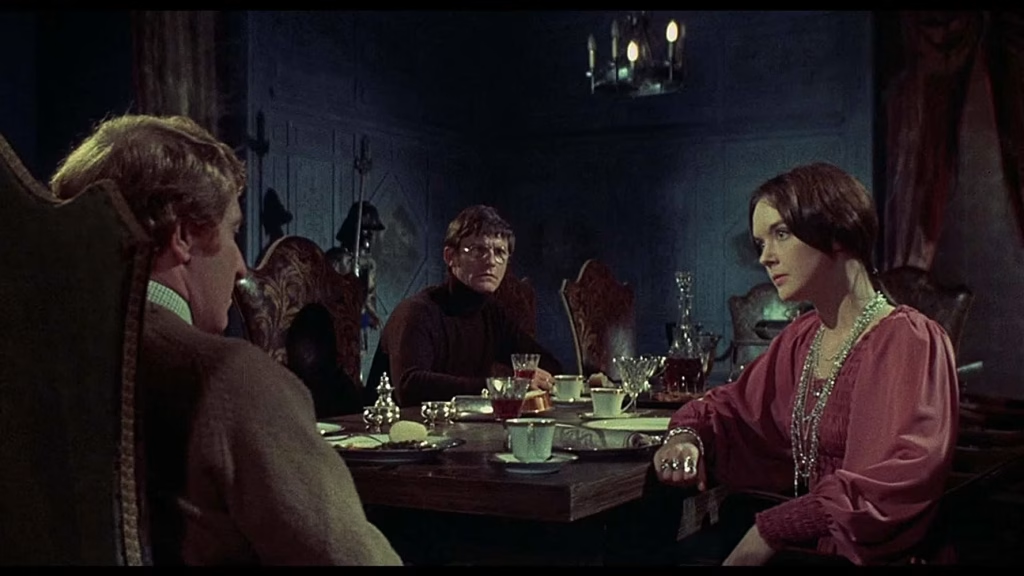
Belasco House, often referred to as “the Mount Everest of haunted houses,” is as much a character as the protagonists. Its gothic architecture, decaying grandeur, and oppressive silence create an immediate sense of unease. The film masterfully uses the environment to amplify the horror. Doors slam shut inexplicably, objects move on their own, and strange noises echo through the empty halls. The house doesn’t just contain the evil. It seems to emanate the evil, pressing down on the inhabitants both physically and psychologically.
The history of Emeric Belasco, the “Roaring Giant,” adds another layer of grim fascination. A wealthy and depraved man, Belasco indulged in every imaginable vice within the house’s walls, culminating in a grotesque spree of murder and sadism. His presence, though unseen, permeates every room, leaving a lingering stain of his wickedness.

Psychological Warfare and Shifting Dynamics
As the week progresses, the line between scientific inquiry and psychological torment blurs. Dr. Barrett, initially confident in his electromagnetic theories, finds his resolve tested as the phenomena escalate beyond simple explanations. Ann, already susceptible, descends further into paranoia and fear, experiencing vivid nightmares and unsettling visions.
The most dramatic changes occur in Florence and Ben. Florence, with her heightened sensitivity, becomes the primary conduit for the house’s malevolence. She is tormented by visions and manipulated by the entity, her desire to help often leading her into greater danger. Ben, on the other hand, struggles to maintain his composure, haunted by the memories of his last encounter with Belasco House. His fear is palpable, serving as a constant reminder of the house’s potential for destruction.
The film excels at portraying the subtle ways the house manipulates its occupants, preying on their vulnerabilities and desires. It uses their deepest fears and hidden desires against them, creating rifts within the group and pushing them to the brink of madness.


The Nature of the Haunting: Poltergeist or Something More?
Dr. Barrett’s initial hypothesis is that the house is plagued by a powerful poltergeist, a residual energy caused by Belasco’s dark deeds. He attempts to “drain” this energy using his specialized equipment. However, as the haunting intensifies, it becomes clear that a simple poltergeist explanation is insufficient.
The entity in Belasco House exhibits a sinister intelligence. It isn’t just making noise; it’s communicating, manipulating, and actively seeking to possess and destroy. The climax of the film revolves around the revelation of the true nature of the haunting – not a lingering energy, but a conscious, malevolent force, a “composite evil” born from Belasco’s depravity and the souls of his victims.


Visual Style and Direction
John Hough’s direction is a masterclass in subtlety. He avoids jump scares, instead building suspense through meticulous pacing, unsettling sound design, and clever camerawork. The film’s muted color palette and gothic aesthetics enhance the oppressive atmosphere. The visual effects, though simple by today’s standards, are effective in conveying the supernatural occurrences without relying on overt spectacle. The scenes of ghostly manifestations are brief and unsettling, often leaving more to the imagination than revealing explicitly.
Legacy and Influence
The Legend of Hell House may be overshadowed by other horror films of its era. However, it remains a highly respected work within the haunted house genre. It is also an influential work. Its emphasis on psychological terror, well-developed characters, and a nuanced exploration of the supernatural has resonated with audiences and filmmakers alike. It stands as a testament to the power of suggestion and atmosphere in creating truly terrifying cinema, proving that sometimes, what you don’t see is far more frightening than what you do. For fans of intelligent, character-driven horror, The Legend of Hell House is an absolute must-watch.
To read the rest of my Monstrous Movie Reviews, click HERE! To add this amazing movie to your film library, click on the Blu-ray movie cover below.

