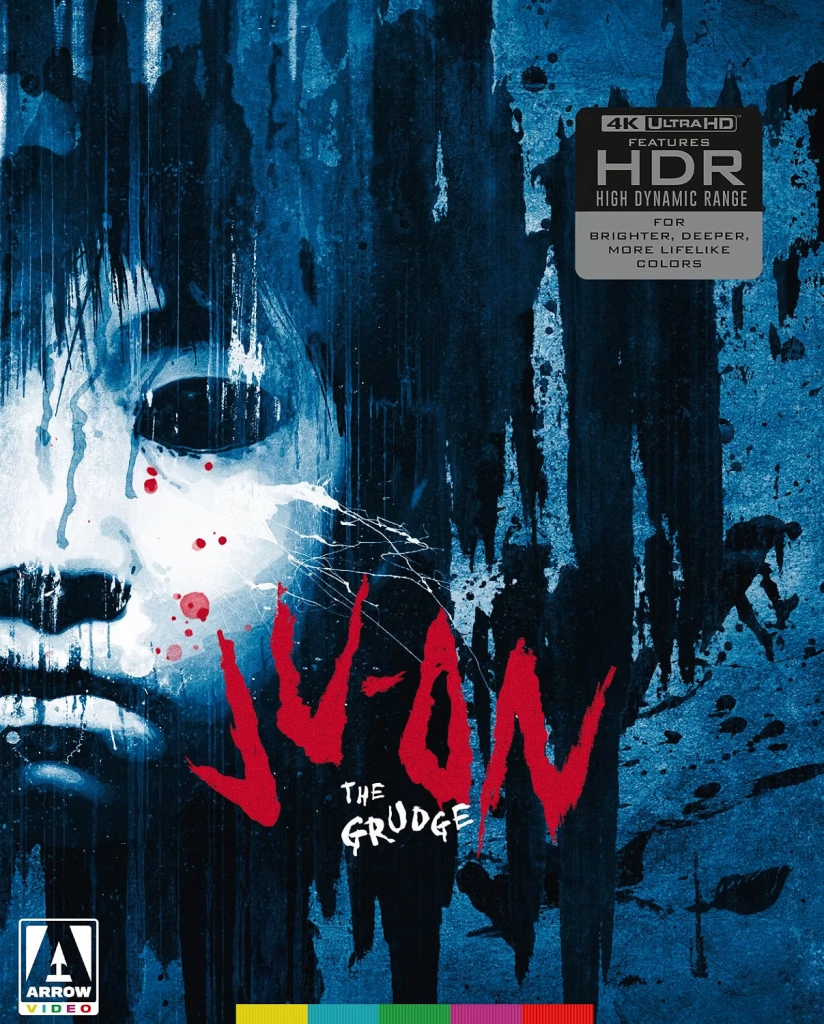
Written and directed by Takashi Shimizu, Ju-On: The Grudge (2002) is a cornerstone of the early-2000s J-horror boom. While Shimizu had already explored the core mythology through two low-budget, direct-to-video releases in 2000 (Ju-On: The Curse 1 & 2), the 2002 theatrical release refined his fragmented storytelling style and introduced the pale, contorting figures of Kayako and Toshio Saeki to an international audience.


The Central Mythology
The film opens with an onscreen epigraph outlining the premise:
“Ju-on: a curse born from the dying rage of someone who died under extreme circumstances. It gathers in the places that person inhabited, and whoever encounters it will die, and a new curse will be born.”
Unlike classic Western ghost stories, where spirits are bound by unfinished business or can be put to rest by solving a mystery, the entity in Ju-On is purely contagious and absolute. Entering the cursed Nerima suburban home guarantees death. There is no morality, no bargaining, and no survival—the curse functions more like a lethal viral outbreak than a haunting.


Non-Linear Narrative Structure
The film dispenses with conventional three-act storytelling, arranging its narrative into six interconnected, out-of-sequence vignettes named after the character targeted in each segment:
- Rika: A volunteer social worker assigned to check on an elderly, catatonic woman named Sachie Tokunaga. Rika discovers Sachie’s terrified grandson Toshio taped inside an upstairs closet before witnessing Sachie attacked by a shadow entity.
- Katsuya: Flashes backward to show Sachie’s son, Katsuya, and his wife, Kazumi, moving into the house. The curse quickly degrades Katsuya’s mental stability, leading to their deaths.
- Hitomi: Katsuya’s sister, who experiences spectral encounters at her office and apartment after visiting the house. It contains one of the film’s signature sequences—a spirit creeping beneath her bedcovers.
- Toyama: Follows a retired detective who originally investigated the Saeki family murders years prior. He attempts to burn the house down to halt the cycle, but finds himself disoriented by overlapping temporal visions of his daughter’s future.
- Izumi: Toyama’s teenage daughter, tormented years later by phantom visions and guilt after taking friends to the infamous house on a dare.
- Kayako: The concluding chapter detailing Rika’s ultimate return to the house and revealing the origins of the curse through the murder of Kayako and Toshio by her husband, Takeo Saeki.


Sound Design and Practical Horror
Rather than relying on swelling orchestral stingers or digital visual effects, Shimizu anchored the scares in tactile, unsettling sensory details:
- The Death Rattle: Kayako’s presence is heralded by an erratic, guttural croaking sound. Shimizu produced this audio himself by rattling air through his throat into a microphone, simulating the sound of someone trying to breathe through a severed windpipe.
- Physical Contortion: Played by classically trained butoh dancer Takako Fuji, Kayako moves with unnatural, disjointed joint articulations. Her slow descent down the staircase remains one of the defining visual motifs of modern Asian horror cinema.
- Subverting Safe Spaces: Shimizu deliberately staged attacks in broad daylight and mundane environments—under bedcovers, inside well-lit elevators, and through office security cameras—undermining the viewer’s expectation that horror only manifests in darkness.


Legacy and Remakes
Ju-On: The Grudge helped solidify the global appetite for Japanese horror ignited by Hideo Nakata’s Ringu (1998). Its success led directly to the 2004 American remake, The Grudge, produced by Sam Raimi and also directed by Shimizu. The franchise subsequently expanded into numerous sequels, crossovers (Sadako vs. Kayako), and a 2020 Netflix origin series (Ju-On: Origins). The 2002 film remains the critical and tonal peak of the property due to its bleak nihilism and refusal to grant its victims any path to salvation.
To read the rest of my Monstrous Movie Reviews, click HERE! To add this movie to your film collection, click on the Blu-ray cover below.