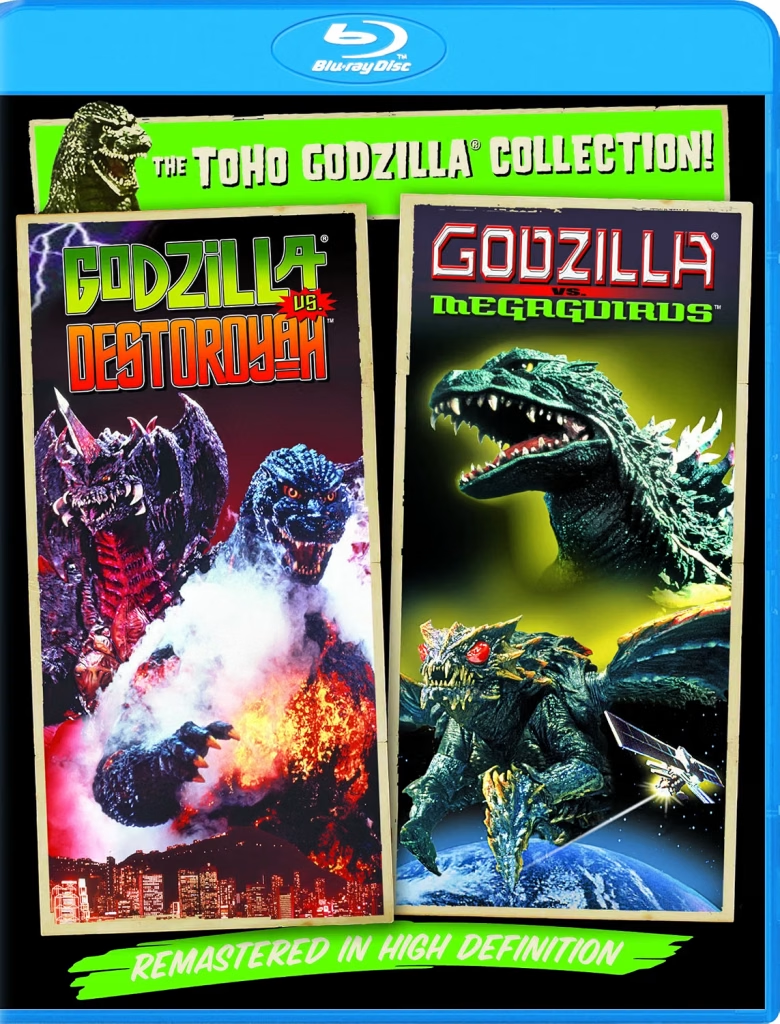
Released in December 2000, Godzilla vs. Megaguirus (Gojira tai Megagirasu: Jī Shōmetsu Sakusen) marked the 24th installment in Toho’s long-running kaiju franchise and the second entry in the Millennium era. Directed by Masaaki Tezuka with special effects directed by Kenji Suzuki, the film sought to refine the tone set by 1999’s Godzilla 2000: Millennium, blending pulp science fiction, high-tech military hardware, and classic suitmation action.

Alternate History and Premise
Unlike the Heisei era’s continuous narrative continuity, the Millennium series frequently reset its timeline. Godzilla vs. Megaguirus operates in an alternate timeline where the events of Ishirō Honda’s original 1954 Godzilla occurred, but the monster was never killed by the Oxygen Destroyer:
- 1954–1966: Godzilla returns repeatedly to attack Japan. Recognizing that the creature feeds on nuclear energy, the Japanese government completely phases out nuclear power.
- 1996: Clean plasma energy replaces nuclear power, but Godzilla attacks the research facility in Osaka to devour the new energy source. Major Kiriko Tsujimori (Misato Tanaka) of the Japan Self-Defense Forces loses her commanding officer in the attack, sparking a fierce personal vendetta.
- 2001 (The Present): Tsujimori becomes part of the “G-Graspers,” an elite military unit tasked with deploying the Dimension Tide—a satellite-mounted superweapon capable of firing a miniaturized black hole to swallow Godzilla whole.

The Origin of Megaguirus
The film’s primary antagonist is directly tied to the military’s weapon test. When the Dimension Tide test-fires into a forest outside Tokyo, the micro-black hole tears an ephemeral rift in spacetime:
- The Meganula Egg: A prehistoric dragonfly egg from the Carboniferous period slips through the portal before it closes. A curious boy retrieves it and eventually dumps it in the Tokyo sewer system.
- The Swarm: The egg hatches into an army of subterranean predators known as Meganuron (a direct homage to the giant larvae in Toho’s 1956 film Rodan). They flood Tokyo and metamorphose into winged Meganula.
- The Queen: The swarm swarms Godzilla to siphon his energy, transmitting that stolen bio-nuclear radiation to their queen. The queen molts into Megaguirus, a gargantuan, hyper-agile insectoid with scythe-like limbs, a high-frequency sonic buzz, and an energy-draining stinger.

Production and Visual Style
Godzilla vs. Megaguirus leaned heavily into dynamic, fast-paced creature combat. Kenji Suzuki and the effects team combined traditional miniature cityscapes with wirework, animatronics, and emerging CGI techniques:
| Production Aspect | Details |
|---|---|
| Suit Design | Retained the “MireGoji” design from Godzilla 2000, featuring aggressive, jagged purple dorsal plates, a reptilian snout, and olive-green scales (worn by suit actor Tsutomu Kitagawa). |
| Pacing & Action | Megaguirus moved at blinding speeds, forcing the fight choreography to abandon traditional slow brawling in favor of aerial charges, mid-air dodges, and high-impact physical counters. |
| Notable Stunts | Features one of the most famous and deliberately over-the-top moves in the Millennium era: Godzilla performing a mid-air body slam/belly flop to crush Megaguirus. |
| Score | Composed by Michiru Ōshima, delivering an orchestral score dominated by brass and percussion that became one of the most celebrated soundtracks of modern kaiju cinema. |

Reception and Legacy
Despite delivering strong action sequences and an energetic score, Godzilla vs. Megaguirus struggled at the domestic box office, drawing approximately 1.35 million admissions and underperforming relative to Toho’s expectations. Its box-office disappointment led Toho to pivot dramatically for the next film, hiring Gamera trilogy director Shusuke Kaneko to helm the darker, folklore-driven Godzilla, Mothra and King Ghidorah: Giant Monsters All-Out Attack(2001).
Over time, Godzilla vs. Megaguirus has found appreciation among franchise fans as an earnest, fun piece of early-2000s sci-fi tokusatsu that effectively integrated classic monsters into modern military speculative fiction.
To read more of my entries in my KAIJU KONNECTION series, click HERE. To add this movie to your collection, click on the Blu-ray cover below.