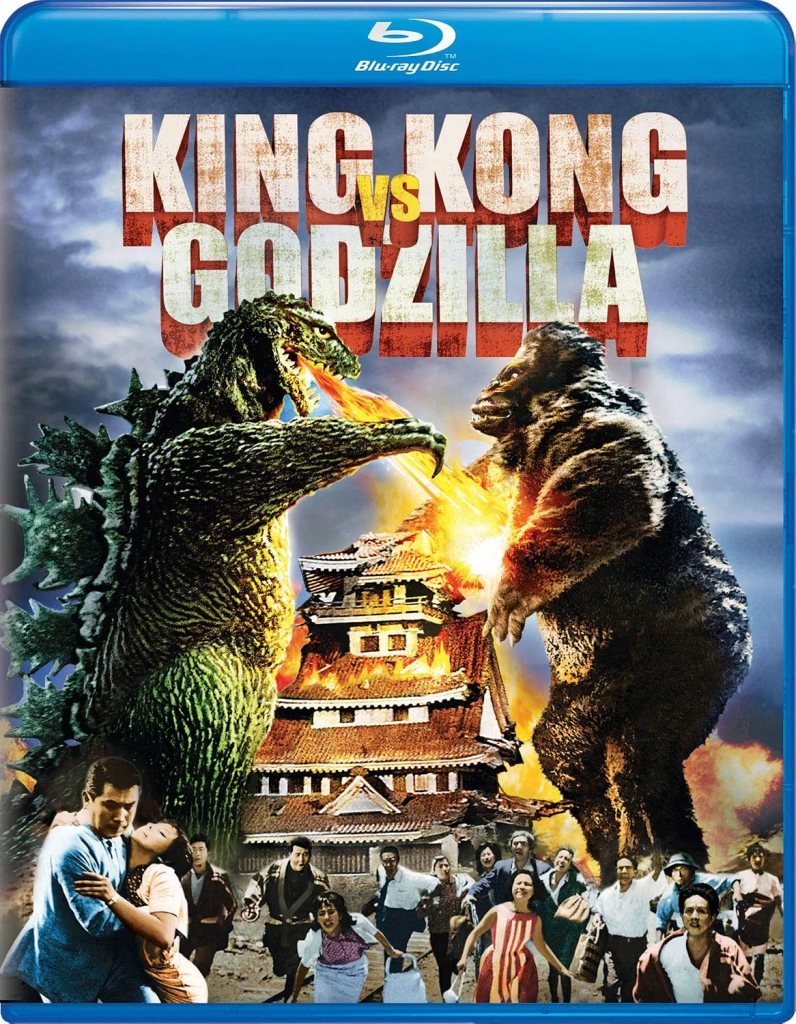
Released in Japan on August 11, 1962, King Kong vs. Godzilla (Kingu Kongu tai Gojira) represents a transformative watershed moment for cinema’s two most iconic giant monsters. Produced by Toho Studios to commemorate its 30th anniversary, the film brought Ishirō Honda back to direct, with Eiji Tsuburaya supervising special effects. It marked the first time either titan appeared in color and Tohoscope anamorphic widescreen, reshaping Godzilla from a grim, monochrome allegory for atomic devastation into a dynamic pop-culture spectacle.

Origins: Willis O’Brien’s Unmade Pitch
The collision of these two behemoths originated in the United States, not Japan. Willis O’Brien, the pioneer of stop-motion animation behind the 1933 King Kong, conceived a treatment in the late 1950s titled King Kong Meets Frankenstein (later renamed King Kong vs. the Frankenstein Monster). O’Brien’s scenario involved Kong battling a giant composite beast created by Frankenstein’s descendant in San Francisco.
Producer John Beck acquired the treatment from O’Brien and took the concept abroad after American studios passed. Beck pitched the property to Toho, who had long sought to make a King Kong film and saw an opportunity to revive Godzilla, who had remained dormant since 1955’s Godzilla Raids Again. Toho purchased the rights from RKO for roughly $200,000, replaced the Frankenstein creature with Godzilla, and sidelined O’Brien entirely—a move that left the animator heartbroken prior to his death in 1962.

Plot and Satirical Subtext
While the narrative delivers on creature combat, screenwriter Shinichi Sekizawa embedded the film with sharp satire aimed at post-war Japan’s burgeoning consumerism and competitive television industry.
The plot centers on Mr. Tako, the publicity director of Pacific Pharmaceuticals, who is frustrated by the dismal TV ratings of the company-sponsored science program. When rumors emerge of a giant deity on Faro Island, Tako dispatches two employees—Kinsaburo Sakurai and Osamu Furue—to capture it as an advertising mascot. The deity is King Kong, whom they drug with native juice and haul across the Pacific on a giant raft.
Simultaneously, an American nuclear submarine crashes into an iceberg in the Arctic, awakening Godzilla from his frozen slumber. Godzilla marches toward Japan, laying waste to military defenses. When Kong escapes near Japan, the two titans converge, turning the country into an arena. Toho’s government response culminates in “Operation Burial” and a logistical maneuver using electrical wire and helium balloons to transport a tranquilized Kong directly to Mount Fuji to face Godzilla.

Special Effects and “Suitmation” Evolution
Eiji Tsuburaya discarded stop-motion animation due to budget and timeline constraints, relying instead on his signature “suitmation” technique alongside scale miniatures, hand puppets, and optical matting.
- Godzilla (Sutegojira): Portrayed by veteran stuntman Katsumi Tezuka and Haruo Nakajima, the Godzilla suit was heavily remodeled. It lost the mammalian ears and fangs of earlier suits, gaining a bulkier, reptilian profile, three toes per foot instead of four, and larger dorsal fins.
- King Kong: Played by Shoichi Hirose, Kong was given an elongated arm mechanism with internal poles to emulate ape-like proportions. Because Kong was traditionally stop-motion, adapting the character to a costume proved challenging, resulting in a distinct, woolly appearance that drew mixed reactions.
- Creature Combat Choreography: Rather than the stiff, terrifying destruction seen in 1954, Tsuburaya embraced a dynamic, wrestling-inspired approach (puroresu). Kong and Godzilla exchange boulders, execute shoulder throws, and at one point, Kong famously shoves a tree trunk into Godzilla’s jaws.
- The Giant Octopus: For the Faro Island confrontation, Tsuburaya filmed live octopuses crawling across miniature huts, blending them with miniature puppet work. Four live octopuses were used; three were released, and one reportedly became Tsuburaya’s dinner.

The Duel’s Outcome and the Two-Endings Myth
For decades, an urban legend persisted in Western pop culture claiming there were two separate endings: one where Godzilla won for Japanese audiences, and another where Kong won for American audiences.
This myth is false. In both versions, the outcome is identical:
- Kong, revitalized by an atmospheric thunderstorm (a plot device granting him electrical powers, a remnant of the Frankenstein script), battles Godzilla down to the Atami coastline.
- Both monsters tumble off the cliffs of Mount Fuji into the ocean.
- Only King Kong resurfaces, paddling across the sea back toward Faro Island, while Godzilla remains unseen beneath the water.
Toho’s official press materials declared King Kong the victor by a technical knockout. Kong was considered the bigger worldwide box-office draw in 1962, making a definitive loss unacceptable to the licensing agreement with RKO.

The Japanese vs. American Cuts
John Beck sold the U.S. distribution rights to Universal-International, which drastically altered the film for Western audiences in 1963.
| Feature | Japanese Original (1962) | U.S. Release (1963) |
|---|---|---|
| Tone | Satirical comedy, media critique | Serious monster-thriller framing |
| Score | Original symphonic music by Akira Ifukube | Stock library tracks, mostly from Creature from the Black Lagoon |
| Pacing | Organic character interactions and subplots | Interrupted by mock news broadcasts |
| Added Scenes | None | UN reporter Eric Carter (Michael Keith) in a news studio |
| Runtime | 97 minutes | 91 minutes |
The American edit stripped out much of Sekizawa’s corporate media satire, substituting scientific exposition and diagrams presented by Western actors to ground the fantastical premise for American audiences.

Box Office Impact and Cultural Legacy
King Kong vs. Godzilla was a historic financial triumph for Toho. It sold 11.2 million tickets during its initial Japanese theatrical run—a milestone that still stands as the highest attendance record for any live-action Godzilla film in history (and 12.55 million including re-releases).
The film’s runaway commercial success established the formula for the subsequent Showa-era Godzilla series: colorful monster-versus-monster battles, anthropomorphic fighting styles, and increased appeal to family audiences. Without the staggering box-office returns of this 1962 clash, Toho likely would not have continued investing in the Godzilla franchise, which went on to become one of the longest-running continuously produced film properties in cinema history.
To read more of my entries in my KAIJU KONNECTION series, click HERE. To add this movie to your collection, click on the Blu-ray cover below (please note: this release is for the US dub of this movie only). To own the Japanese version of the film, subtitled in English, you will need to add the Showa Series Criterion Godzilla Collection shown below.