The Pukwudgie (also spelled Puckwudgie or Bagwajinini) is one of the most enduring and feared entities in Indigenous North American folklore. Originating within Algonquian-speaking traditions—most prominently among the Wampanoag, Lenape, Abenaki, and Ojibwe—the name roughly translates to “person of the wilderness” or “little wild man of the woods that vanishes”.
Physical Appearance
Across oral histories and regional reports, descriptions of the Pukwudgie share striking, goblin-like characteristics:
- Stature: Standing roughly two to three feet tall (knee-high to an adult).
- Features: Exaggerated, enlarged noses, pointed or protruding ears, long fingers, and smooth, grey-toned skin.
- Porcupine Quills: A unique trait in many Southern New England traditions is a crest or ridge of sharp spines running from the crown of the head down the back, causing them to resemble an upright porcupine from behind.
- Scent: Despite their grotesque or rugged appearance, some traditions note they carry an unnerving, sweet floral scent.

Folklore and Cultural Origins
While European settlers often conflated them with brownies, goblins, or fae folk, the Pukwudgie’s role depends heavily on tribal context:
| Tradition / Region | Temperament | Role in Oral Lore |
|---|---|---|
| Ojibwe & Great Lakes | Mischievous trickster | Mostly harmless pranksters (Bagwajinini) who confound travelers or pilfer game. |
| Abenaki (Northern New England) | Retaliatory neutral | Generally mind their own affairs; dangerous only when humans trespass or show disrespect. |
| Wampanoag (Southern New England) | Capricious to outright lethal | Spiteful adversaries capable of kidnapping, arson, and murder. |

The Wampanoag Feud with Maushop
In Southern New England lore, Pukwudgies were not always hostile. Legends say they once coexisted with humans and attempted to offer aid, but their bungling efforts caused frustration. Over time, humans turned their admiration toward Maushop, the benevolent creation giant of Cape Cod and the islands.
Consumed by jealousy, the Pukwudgies began harassing tribes by stealing food and throwing sand into people’s eyes. Humans appealed to Maushop and his wife, Granny Squannit. Enraged, Maushop gathered up the Pukwudgies and hurled them across New England and toward the Great Lakes. The survivors crept back with a vengeance. According to tradition, they ambushed Maushop’s five sons with magic poison arrows, and in some cycles, even brought about the demise or exile of Maushop himself.

Supernatural Abilities
Folklore attributes an array of magical and deceptive powers to Pukwudgies:
- Vanishment & Invisibility: The ability to dissolve into thin air or step between dimensions at will.
- Shapeshifting: Often transforming into dangerous animals, such as cougars, bears, or oversized porcupines.
- Will-o’-the-Wisps: Manipulating spectral fire or Tei-Pai-Wankas (marsh orbs) to bait travelers off trailheads, into bogs, or off high cliffs.
- Poison Weaponry: Firing minute, deadly darts tipped with hemlock, rattlesnake venom, or botanical toxins.
- Mental Influence: Bewildering intruders, inducing memory loss, or using a “death stare” to incapacitate victims.

Modern Sightings and Pop Culture
The creature shifted into modern cryptozoological and paranormal investigation through persistent encounter reports in Massachusetts’ Bridgewater Triangle—most notably within the dense cedar swamps of Hockomock Swamp and the rocky ledges of Freetown-Fall River State Forest. Hikers and park rangers have reported eerie whistle calls, unexplained projectile stones, and brief sightings of two-foot-tall humanoids peering from behind trees before vanishing.
Beyond New England, amateur archeologist Paul Startzman recorded several accounts at Mounds State Park in Anderson, Indiana, where Lenape presence was historically established.
In modern fiction, the Pukwudgie reached global audiences when J.K. Rowling selected it to represent one of the four houses of Ilvermorny School of Witchcraft and Wizardry in North American wizarding lore, defining the house as one representing the heart and fiercely independent healers. Nonetheless, in traditional Indigenous myth, the rule of the woods remains simple: leave them alone, never throw stones, and never answer their calls from the trees.
Modern sightings of Pukwudgies within southeastern Massachusetts concentrate heavily around the Bridgewater Triangle—a 200-square-mile zone of documented paranormal activity and folkloric high strangeness anchored by the Hockomock Swamp and the 5,000-acre Freetown-Fall River State Forest. While folkloric accounts reach back centuries, late 20th- and 21st-century reports have transitioned the creature into contemporary cryptozoology.

The Assonet Ledge Phenomena
The highest concentration of malevolent reports inside Freetown State Forest centers on The Ledge (often called Assonet Ledge), a sheer, 80-foot granite drop overlooking a flooded quarry.
- Luring and Compulsion: Local lore and paranormal investigators link the ledge’s disproportionate history of unexplained falls and suicides directly to the Pukwudgie tradition of luring travelers over cliffs.
- Apparitions on the Precipice: Eyewitnesses describe seeing small, two-to three-foot-tall humanoids perched on the rocky crest at dusk. Several hikers have claimed feeling sudden, overwhelming waves of disorientation, accompanied by the auditory illusion of whispers or footsteps urging them closer to the rim.

Key Modern Eyewitness Accounts
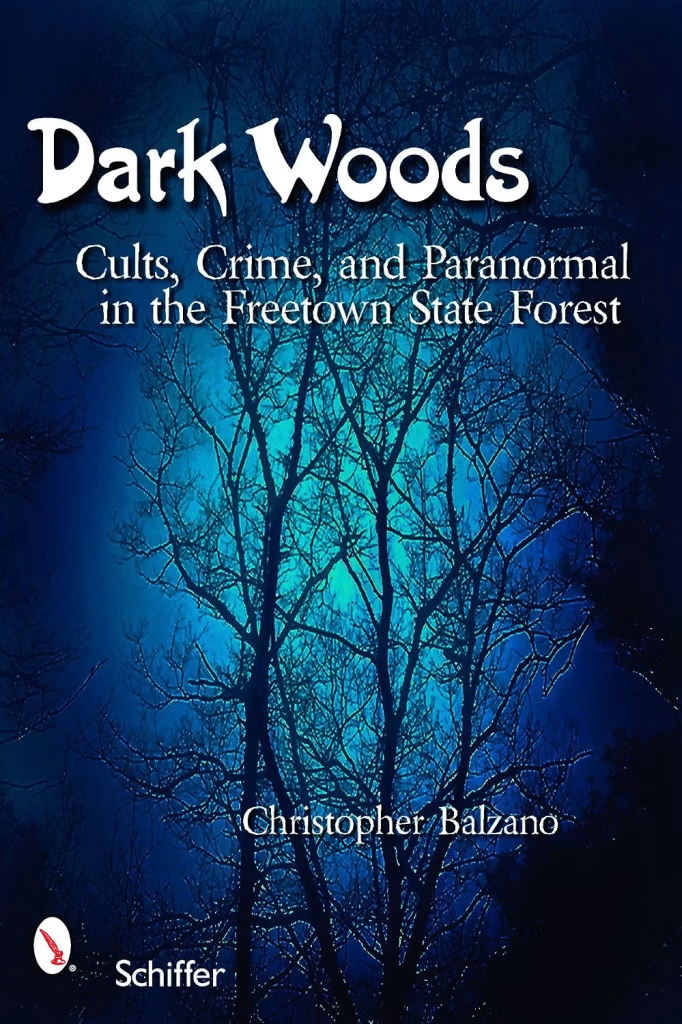
Paranormal researchers such as Christopher Balzano (author of Dark Woods: Cults, Crime and the Paranormal in the Freetown State Forest) and documentary filmmakers have documented several notable encounters:
- The Bill Russo Encounter (Raynham, 1990): While walking his dog late at night near woods boarding the Hockomock Swamp, local writer Bill Russo reported encountering a roughly three- to four-foot-tall bipedal figure standing beneath a streetlight. He described it as pot-bellied, covered in grey-brown fur, with an animal-like (“chipmunk-like”) face. The creature raised a hairy hand, beckoned to him, and repeated an eerie, high-pitched vocalization that sounded like “keer… keer”—which Russo interpreted phonetically as “come here”. His dog, known for being aggressive toward wild animals, shrank back in terror before they both fled.
- The “Joan” Stalking Incident (Freetown Forest): Documented by Balzano, a local resident named Joan was walking her dog along a trail when she spotted a short, grey-skinned humanoid with deep green eyes and hair on its head and arms staring at her from the underbrush. Unnerved, she left the forest immediately. Over the subsequent weeks, she reported seeing the same creature peeking through windows and lurking near the perimeter of her home, suggesting the entity had tracked her from the woods.
- The Breathing Orbs and “Tom’s” Sighting: A witness identified as “Tom” recounted encountering an anomalous white orb of light in Freetown that seemed to “swell like it was breathing” before darting into the treeline. Following the light, he came face-to-face with a two-foot-tall, fur-covered humanoid with a snout-like facial structure that emitted an unearthly wail before fleeing. He reported seeing the same figure months later from a parked car, noting distinct glowing red eyes in the headlights.
- The Boy Scout Incident (1970s): A troop camping deep within Freetown reported small, grey-skinned silhouettes circling the perimeter of their clearing. The scouts claimed the figures threw small stones and sticks at their tents, accompanied by high-pitched, screeching laughter, eventually forcing the troop leaders to evacuate the site in the middle of the night.

Recurring Patterns in Triangle Reports
Eyewitness accounts across Taunton, Freetown, Rehoboth, and Raynham share distinct signatures:
- Auditory Hallmarks: High-pitched, mocking laughter, rhythmic whistling from dense brush, or mimicry of human cries that abruptly stop when approached.
- Physical Harassment: Unseen entities throwing gravel, acorns, or stones from the trees when an intruder stays in one area too long.
- Phantom Lights (Tei-Pai-Wankas): Mysterious blue or pale-white orbs drifting knee-high above swamp water or through thick brush, matching the traditional belief that Pukwudgies deploy spectral fire to disorient night travelers.Urban Legends Mystery And Myth
- Canine Reaction: Almost all witnesses report that hunting dogs or guard dogs freeze, whimper, and refuse to approach the brush where the figure is hiding.
If you liked this blog, don’t forget to read other entries in my BASEMENT’S WORLD OF THE WEIRD series. If you’d like to read more about the Freetown State Forest, click on the book cover below.