

Released in the summer of 1979, The Amityville Horror stands as one of the most commercially successful and culturally influential supernatural horror films of the late 20th century. Directed by Stuart Rosenberg and adapted by Sandor Stern from Jay Anson’s bestselling 1977 novel, the film capitalized on a hungry public’s fascination with the occult, true crime, and things that go bump in the night.
Despite weathering mixed-to-negative reviews from contemporary critics, the film struck a primal nerve with audiences, cementing its status as a foundational text for the modern haunted house subgenre.

1. Premise and Plot Summary
The film opens with the stark, brutal reality that birthed the legend: in November 1974, Ronald DeFeo Jr. shot and killed six members of his family inside their Dutch Colonial home at 112 Ocean Avenue in Amityville, New York.
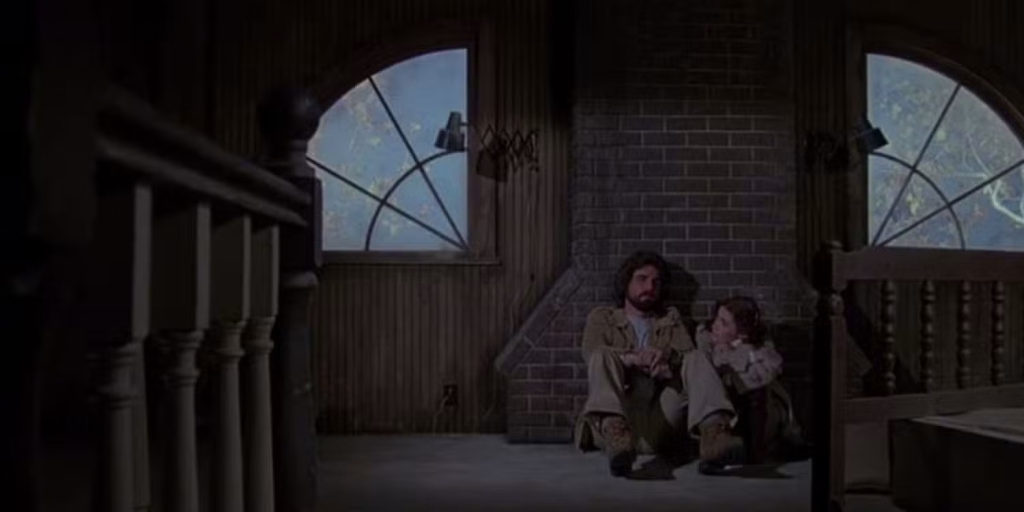
One year later, a young, working-class couple, George and Kathy Lutz (played by James Brolin and Margot Kidder), buy the idyllic waterfront house at a bargain price, fully aware of its grim history. They move in with Kathy’s three children, hoping for a fresh start.
Almost immediately, the house begins to exert a malevolent influence over the family:
- The Descent of George: George becomes increasingly unhinged, obsessive, and cold. He neglects his business, spends hours chopping wood in the freezing cold, and takes on a striking physical resemblance to the portraits of the murderer.
- Supernatural Disturbances: The home is plagued by swarms of flies, slime oozing from the walls, mysterious slamming doors, hidden rooms, and demonic entities manifest in physical forms—most famously, glowing red eyes peering through an upstairs window at night.
- The Church’s Defeat: A local priest, Father Delaney (Rod Steiger), attempts to bless the house, but is violently rebuffed by unseen demonic forces, leading to his psychological and physical breakdown.
As the terror peaks—with crucifixes turning upside down and the house seemingly trying to swallow them whole—the Lutzes flee in terror, leaving behind all their possessions.

2. Key Production Details
- Cast & Crew: James Brolin underwent a stark physical transformation for the role, growing a ragged beard and losing weight to map George’s psychological decay. Margot Kidder—fresh off her stardom in Superman (1978)—brought a grounded, frantic terror to Kathy. Veteran actor Rod Steiger delivered a famously intense, sweat-drenched performance as the tormented clergyman.
- The Iconic House: Though the events allegedly took place in Amityville, New York, the actual house used for exterior shots was located in Toms River, New Jersey. The iconic Dutch Colonial “eye” windows had to be temporarily added to the structure for filming and later altered after production to deter tourists.
- Lalo Schifrin’s Score: The film’s eerie, chilling lullaby-esque theme song, “The Amityville Horror,” earned an Academy Award nomination for Best Original Score, helping to stitch the movie into the cultural fabric.

3. Box Office Reception and Cultural Legacy
While major critics like Roger Ebert panned the film as “dreary and terminally depressing” with an “invisible bad guy”, moviegoers disagreed entirely. Distributed by American International Pictures (AIP), The Amityville Horror became a massive blockbuster.
Key Success Metrics
- Production Budget: ~$4.7 million
- Box Office Gross: Over $86 million domestically in its initial run (translating to hundreds of millions adjusted for inflation).
- Historical Standing: For a brief period, it held the record as the highest-grossing independent film of all time before being overtaken later that year by John Carpenter’s Halloween.

4. The “True Story” Debate
Much of the film’s initial marketing leaned heavily on the claim that it was “based on a true story”. George and Kathy Lutz maintained that they experienced genuine demonic phenomena during their 28 days in the house.
However, subsequent investigations—including revelations that the Lutz family’s lawyer, William Weber, helped concoct elements of the haunting alongside the family over several bottles of wine—cast severe doubt on the narrative. Despite being widely debunked as a hoax or an exaggerated cash grab, the blurring lines between “fact” and “fiction” gave the film a dangerous, forbidden allure that heightened its box office appeal in 1979.
5. Enduring Influence
The original film spawned an unwieldy multimedia franchise, including direct sequels (Amityville II: The Possession), 3D entries, a 2005 Hollywood remake starring Ryan Reynolds, and dozens of low-budget, unrelated straight-to-video features that utilized the “Amityville” name due to its lack of copyright protection.
Today, Stuart Rosenberg’s 1979 feature remains a touchstone of 1970s horror. It tapped into anxieties regarding domestic spaces, economic vulnerability, and the fragility of the American nuclear family—proving that sometimes, the scariest place on Earth is the mortgage you just signed.
To read the rest of my Monstrous Movie Reviews, click HERE! To add this movie to your film collection, click on the Blu-ray cover below.
