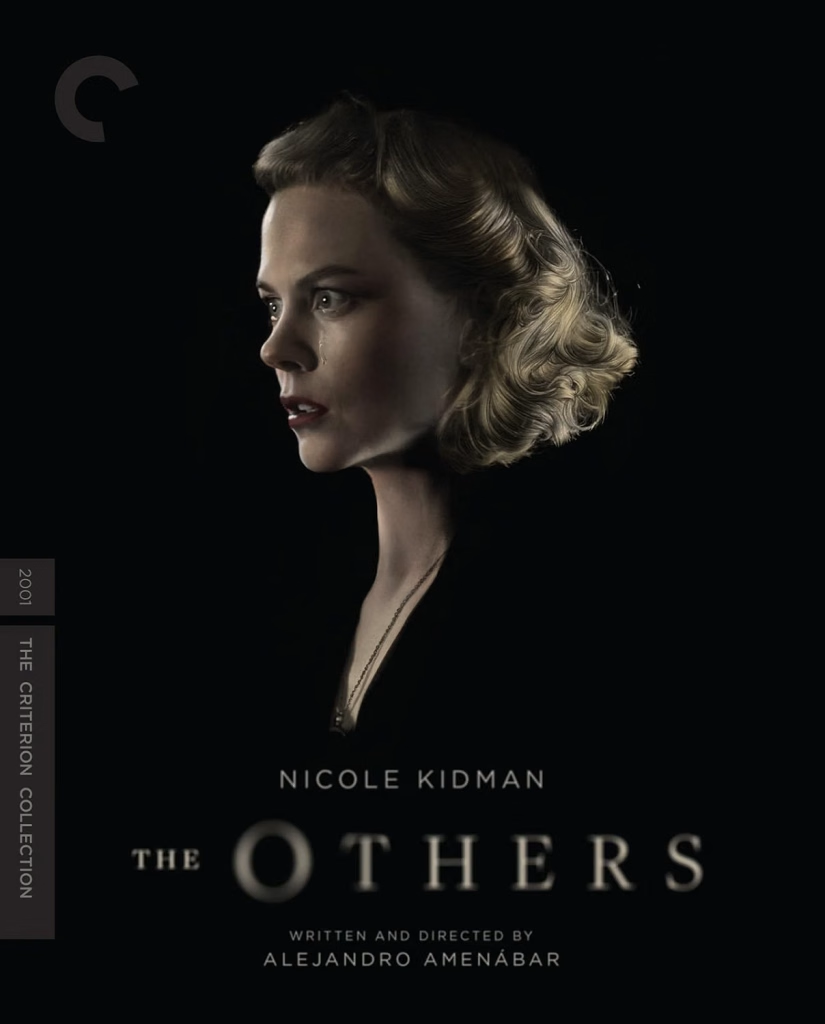
Alejandro Amenábar’s 2001 gothic horror masterpiece, The Others, remains one of modern cinema’s most elegant exercises in psychological dread. Released in an era increasingly dominated by visceral slasher tropes and heavy CGI, the film opted instead for an old-school, Victorian-infused restraint reminiscent of Henry James’s The Turn of the Screw and Shirley Jackson’s The Haunting of Hill House.

The Premise: Light as an Enemy
Set in 1945 on the fog-drenched English Channel island of Jersey just after World War II, the story follows Grace Stewart (Nicole Kidman), a devout Catholic mother awaiting news of her missing husband. Grace lives in a sprawling, isolated manor with her two young children, Anne (Alakina Mann) and Nicholas (James Bentley).
Both children suffer from severe xeroderma pigmentosum—a rare photo-sensitivity condition where direct exposure to sunlight causes burns and sores. This medical reality establishes the film’s central mechanical rule: no door must ever be opened before the previous one is locked, and curtains must remain drawn at all times. Darkness becomes the family’s sanctuary, upending the classic horror archetype where light represents safety.
The fragile domestic order unravels when three mysterious servants arrive seeking work: housekeeper Mrs. Mills (Fionnula Flanagan), elderly gardener Mr. Tuttle (Eric Sykes), and mute housemaid Lydia (Elaine Cassidy). Soon after, Anne claims to see intruders—a boy named Victor and an old woman—prompting Grace to spiral into paranoid mania.

Narrative Architecture and Subversion
Amenábar, who wrote, directed, and composed the haunting orchestral score, crafts tension not through gore, but through acoustics and negative space:
- Creaking Parquet and Velvet Silence: Sound design takes precedence over visuals. Piano keys playing in locked rooms and muffled footsteps upstairs generate terror out of ordinary spaces.
- The “Book of the Dead”: Grace discovers Victorian post-mortem photography albums, introducing the pervasive presence of death before the supernatural fully takes shape.
- The Climax and the Inversion: The film’s renowned twist—revealed during a séance seen from the ghosts’ perspective—upends the entire narrative. The intruders are the living new owners, and Grace, Anne, Nicholas, and the servants are the spirits haunting the estate. Grace, in a past moment of postpartum despair and wartime grief, smothered her children before turning a gun on herself.

Thematic Resonance
Beyond its haunted-house scaffolding, The Others operates as a psychological study of grief, denial, and religious dogma.
| Core Theme | Cinematic Expression |
|---|---|
| Repression & Guilt | Grace’s hyper-controlling rules and insistence on rigid scripture mask her subconscious refusal to accept the murder-suicide she committed. |
| Liminality | The perennially fog-bound island mirrors the characters’ state of Purgatory—neither fully in heaven nor hell, trapped in emotional stasis. |
| The “Other” | The title shifts meaning: the perceived invasive threats are merely living people coping with unexplained hauntings caused by Grace’s own unresolved trauma. |

Critical Legacy and Accolades
The Others was a global box-office triumph, grossing over $209 million worldwide on a modest budget. It earned critical acclaim, leading to multiple prestigious accolades:
- Goya Awards: Dominated Spain’s national film awards with 8 Goyas, including Best Film and Best Director, notably becoming the first film shot entirely in English to win Best Film.
- Award Nominations: Nicole Kidman received nominations for a BAFTA and a Golden Globe for Best Actress, anchoring the film with a performance balancing brittle severity and maternal heartbreak.
By treating horror as an extension of unresolved human grief, The Others stands as a benchmark of modern gothic filmmaking—proving that the most terrifying phantoms are often the memories we refuse to confront.
To read the rest of my Monstrous Movie Reviews, click HERE! To add this movie to your film collection, click on the Blu-ray cover below.