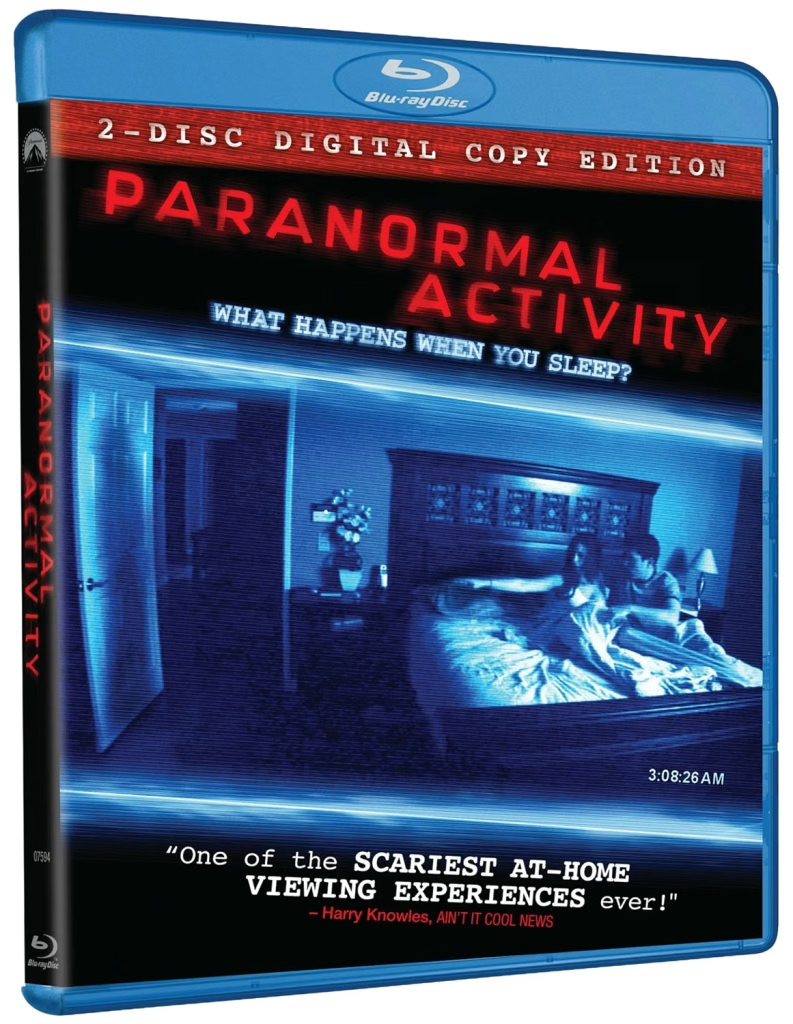
When Oren Peli shot Paranormal Activity in 2006 on a consumer digital camcorder in his own San Diego tract home, he was working with roughly $15,000 and zero professional film experience. By the end of its theatrical run in late 2009, the movie had grossed over $193 million worldwide, making it one of the most profitable feature films ever produced relative to initial budget and permanently shifting the trajectory of modern independent horror.

Origins and Low-Budget Mechanics
Peli, an Israeli-born software programmer and video game designer, conceived the film after moving into a quiet suburban home and becoming hyper-aware of routine nocturnal settling noises. Rather than writing a conventional script, Peli drafted an outline and cast two largely unknown actors, Katie Featherston and Micah Sloat, chosen primarily for their ability to improvise naturally.
The production stripped away nearly every standard filmmaking convention:
- Setting: Filmed over seven days in Peli’s own house in San Diego, California.
- Camera Setup: Micah’s character operating a handheld Sony HDR-FX1, alternating with the camera mounted on a tripod facing the master bed at night.
- Sound Design: Completely devoid of a musical score. Tension relies entirely on room tone, HVAC hums, and low-frequency rumblings (infrasound) signaling the entity’s approach.
- Practical Rigging: In-camera practical effects like monofilament fishing line to tug sheets and open doors, flour scattered on the floor to reveal demonic three-toed prints, and off-camera thuds against drywall.

The Power of the Fixed Night Cam
What set Paranormal Activity apart from earlier found-footage touchstones like The Blair Witch Project (1999) was its mastery of negative space and anticipation.
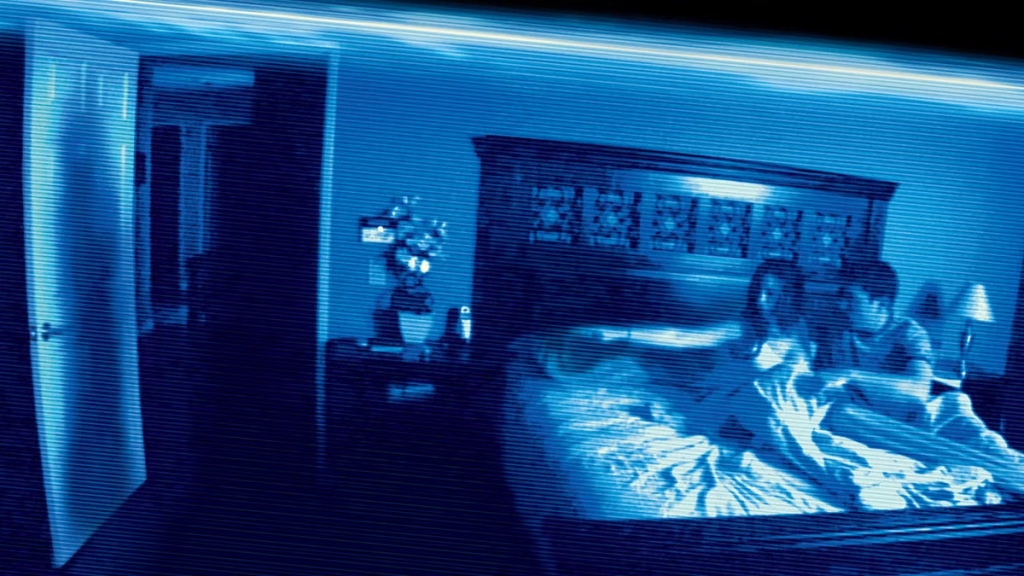
Instead of chaotic handheld running through the woods, Peli anchored the dread to a static, wide surveillance angle of a bedroom. The lower-right timecode became a countdown clock. Audiences were forced to visually scan every corner of the mundane frame—the cracked door, the hallway shadow, the edge of the sheet—searching for micro-movements.
The diurnal rhythm established an escalating cycle: daytime was for rationalization, bickering, and failed research; nighttime was for dread. This formula transformed ordinary suburban comfort into an inescapable trap, exploiting the primal vulnerability of sleep.

From Festival Curio to Studio Phenomenon
The film premiered at the Screamfest Horror Film Festival in October 2007 and screened at the 2008 Slamdance Film Festival, catching the eye of DreamWorks and producer Jason Blum. Initially, the studio purchased the rights intending to remake the film on a larger budget, keeping Peli’s original merely as a DVD extra.
However, a legendary test screening arranged by Steven Spielberg altered that plan. Legend has it Spielberg became convinced the screener DVD was haunted after the door locked him in his bedroom; more importantly, audiences at test screenings were visibly terrified and walking out from sheer anxiety.
Paramount (which distributed through DreamWorks) opted to release the original cut with a new, punchier studio ending, replacing Peli’s original suicide-by-cop finale with the visceral throw-into-the-camera jump scare.
Viral Marketing and Cultural Impact
In the fall of 2009, Paramount launched a pioneering grassroots campaign using the platform Eventful. Night-vision ads featured real theatergoers screaming and clutching one another under the slogan: “Demand It.” Fans had to vote online to bring the film to their local theaters.
The strategy built an aura of an forbidden cinematic event:
- Theatrical Rollout: Began in just 12 college towns in September 2009, expanding nationwide after hitting 1 million online demands.
- Box Office: Dethroned Saw VI at the box office that October, signaling a generational changing of the guard from mid-2000s “torture porn” back to psychological, supernatural minimalism.
- Legacy: It cemented the foundation of Blumhouse Productions’ micro-budget, creator-driven business model, which went on to produce Insidious, The Purge, Sinister, and Get Out.
Paranormal Activity proved that terror does not require sprawling sets or elaborate digital monsters—just an open door, an unmoving camera, and a bump in the dead of night.
To read the rest of my Monstrous Movie Reviews, click HERE! To add this movie to your film collection, click on the Blu-ray cover below.