

Halloween (1978), directed by John Carpenter, stands as a monumental achievement in cinematic horror. It fundamentally reshaped the genre. This was especially true for the slasher subgenre. Its release marked a pivotal moment in that it showed that terror could be crafted effectively and profitably. This was achieved even on a minimal budget. The film’s unique integration with the Halloween holiday further elevated its status, transforming it from a mere cinematic release into an inseparable part of seasonal festivities.
The film’s immediate and sustained financial success was significant. It was achieved with a remarkably modest budget. This signaled a major shift in the economic model for horror cinema. With a production budget estimated between $300,000 and $325,000, Halloween grossed an astonishing $70 million worldwide. This extraordinary return on investment demonstrated that compelling horror did not require lavish spending on special effects and star power. The worldwide box office was over 216 times the production budget. Instead, it highlighted the immense commercial viability of suspense, atmosphere, and a potent villain. This financial triumph directly incentivized a wave of similar low-budget slasher films throughout the 1980s, establishing the slasher as a dominant and economically attractive subgenre. The film thus democratized horror filmmaking, illustrating that creative ingenuity and a clear vision could overcome significant financial limitations.

I. Introduction: The Night He Came Home – A Cinematic Phenomenon
Setting the Stage: The 1978 Release and its Cinematic Landscape
Halloween was released on October 25, 1978. It emerged into a horror landscape that had seen foundational films like Alfred Hitchcock’s Psycho (1960), Tobe Hooper’s The Texas Chain Saw Massacre (1974), and Bob Clark’s Black Christmas (1974). These films introduced elements of psychological terror and proto-slasher tropes. However, Halloween would synthesize and refine these disparate elements into a cohesive and widely emulated formula. The film was a testament to independent filmmaking. It was produced by Compass International Pictures and Falcon International Productions. The distribution was managed by Compass International Pictures and Aquarius Releasing. This independent spirit afforded its creators considerable creative freedom, allowing them to forge a distinct vision outside the conventional constraints of major studio productions.

Core Narrative and Characters
The narrative of Halloween is deceptively simple yet profoundly effective. The film chronicles the return of Michael Myers, chillingly known as “The Shape,” to his quiet hometown of Haddonfield, Illinois. Fifteen years after he murdered his sister on Halloween night in 1963, Michael escapes from a mental institution, initiating a new reign of terror. This straightforward premise taps into primal fears and anxieties associated with suburban life, transforming the familiar into a landscape of dread.
The character of Michael Myers, often referred to as “The Shape,” is depicted as the embodiment of pure evil. He is a being devoid of conscience, empathy, or any discernible sense of right or wrong. John Carpenter’s inspiration for Michael’s chilling malevolence stemmed from a visit to a psychiatric institution during his college years, where he encountered an adolescent boy with a disturbing, blank, “schizophrenic stare”. This experience directly informed the characterization of Michael as an elusive and unsettling “Boogeyman”. His iconic, expressionless mask, a modified Don Post Studios Captain Kirk mask, further contributes to his terrifying anonymity and inscrutability.

Laurie Strode, portrayed by Jamie Lee Curtis, serves as the film’s central protagonist. She is presented as an alert and observant teenager, a stark contrast to her more preoccupied friends. Laurie ultimately embodies the “Final Girl” archetype, a resilient character who recognizes the impending danger and survives the horrific ordeal. Debra Hill, the film’s co-writer, contributed significantly to Laurie’s character and the realistic dialogue among the teenagers, drawing from her own high school experiences.
Dr. Samuel Loomis, Michael’s psychiatrist, is played by the esteemed Donald Pleasence. He provides crucial exposition. He warns of Michael’s inherent and unyielding evil. He famously describes Michael as “purely and simply…evil”, employing a metaphysical concept to grapple with the inexplicable nature of Michael’s malevolence, which defies conventional psychological understanding.

The simplicity of Halloween‘s plot and its well-defined character archetypes was not a limitation. It was a deliberate and highly effective artistic choice. This choice amplified its impact and facilitated its widespread replication. Carpenter avoided complex backstories and convoluted motivations for the killer. He focused the film’s energy on building intense suspense. The oppressive atmosphere took precedence over a detailed narrative. The portrayal of Michael Myers as an embodiment of “pure evil” created a universal, inexplicable threat that resonated deeply with audiences without requiring elaborate explanations. This minimalist approach also proved remarkably efficient and cost-effective for a low-budget production. The narrative was straightforward. The character roles were clear, especially the “Final Girl.” This clarity provided a readily adaptable template for countless subsequent slasher films. The film’s success demonstrated that horror did not need intricate mythology or excessive gore to be terrifying and financially rewarding, thereby inspiring many imitators to adopt similar narrative structures.
II. Crafting Terror on a Shoestring: Production and Artistic Vision
The Art of Constraint: How a Modest Budget Fostered Creative Ingenuity
Halloween was produced on an extraordinarily modest budget, ranging from $300,000 to $325,000. This severe financial constraint necessitated immense resourcefulness and innovation from the filmmaking team. The iconic Michael Myers mask was famously created from a Captain Kirk mask. Production designer and editor Tommy Lee Wallace expertly modified it by widening the eye holes. He also shaved off the sideburns and eyebrows before spray-painting it white. This low-cost solution inadvertently became one of horror cinema’s most recognizable and terrifying visual elements.

Budgetary limitations extended to other aspects of the production. Jamie Lee Curtis’s wardrobe was sourced from JCPenney for under $100. The “insane asylum” from which Michael escapes was depicted simply by people in hospital gowns standing near a fence. This relied on the audience’s imagination rather than expensive sets. To simulate the autumnal setting of Illinois, fall leaves were reused. However, the trees in the California filming locations remained visibly green. The production was also remarkably swift. The script was completed in just three weeks. Principal photography concluded in a mere 20 to 22 days. The rapid pace and tight budget fostered a “family affair” atmosphere, with many young crew members working long hours, sometimes without pay, for the invaluable on-set experience.
The film’s low budget compelled creative solutions that, in retrospect, became its defining strengths and genre innovations. The limited funds prevented elaborate special effects or high-profile actors. This directly led to a reliance on psychological terror. The film also depended on a pervasive atmosphere. Groundbreaking camera work was heavily utilized. The inexpensive Captain Kirk mask, once modified, became iconic for its blank, expressionless quality. It was profoundly unsettling. This allowed viewers to project their deepest fears onto it. The limited budget for gore meant Carpenter had to imply violence rather than explicitly depict it, a choice that often proved far more terrifying and enduring than overt blood and guts. The extensive use of the then-nascent Steadicam (Panaglide) was a high-tech solution to a low-budget problem. It created immersive tension. This was achieved without requiring complex set pieces or multiple camera setups. This innovative use of technology, coupled with the rapid shooting schedule and reliance on natural or minimal lighting, contributed to the film’s raw, realistic, and intensely suspenseful aesthetic. This success story showed how creative limitations could lead to groundbreaking achievements. It inspired independent filmmakers to prioritize ingenuity over expense. This cemented the principle that “less is more” in creating cinematic dread.
John Carpenter’s Masterful Direction: Innovative Cinematography and Pivotal Score
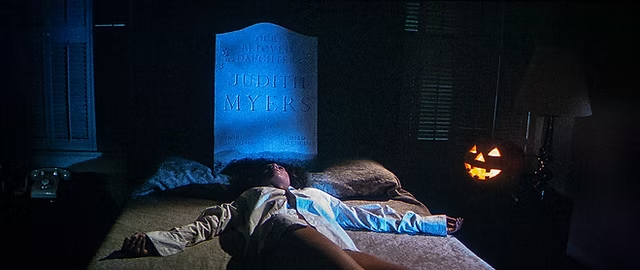
John Carpenter’s directorial vision, executed with cinematographer Dean Cundey, prioritized suspense, atmosphere, and psychological horror over explicit gore. The film famously employed first-person point-of-view (POV) shots, particularly from Michael Myers’ perspective. This technique, notably pioneered in films like Black Christmas, forced a deeper audience participation and identification with the killer. The fluid, smooth movement of these shots was achieved through the use of a Steadicam (Panaglide), making Halloween one of the earliest productions to extensively utilize this revolutionary technology. The challenging four-minute, one-take POV shot, filmed on the last night of production, demanded immense effort and coordination from the crew, highlighting their dedication to Carpenter’s vision.
Carpenter’s direction employed unadorned long takes. It used deliberate pacing. This effectively built tension. It created a claustrophobic subjectivity, making the eventual reveals far more horrifying. The film’s “slow burn” approach was a critical element in establishing its pervasive mood. Visually, the narrative progresses from open suburban areas to increasingly confined spaces as Michael Myers closes in on his victims, culminating in a cramped wardrobe. This escalation of space systematically enhances suspense and anxiety, trapping the audience alongside the characters.

Equally vital to the film’s impact is its iconic music score, composed by Carpenter himself in a mere three days. This minimalist, synthesizer-driven score is widely regarded as one of the most iconic horror film scores ever created. The haunting piano theme and recurring stalking motifs, such as the “Myers Reveal” and “Myers Chase” themes, are intrinsically linked to Michael Myers, signaling his presence and intensifying the dread. The atmospheric soundscape created by the score is so potent that it performs as much “worldbuilding” as the visuals themselves. An anecdote highlights its significance. An executive viewed the initial cut of the film without sound effects or music. Reportedly, he was not scared at all. This prompted Carpenter’s determination to “save it with music”. The score’s pivotal role in the film’s effectiveness is undeniable, and its haunting melodies have since become synonymous with the Halloween holiday itself, frequently featured in haunted houses, parties, and seasonal playlists.
Initial Critical Reception and Evolution
Upon its initial release, Halloween garnered a mixed critical reception. It relied largely on word-of-mouth rather than extensive advertising campaigns to build its audience. Some contemporary critics found it “violent and gory”, a surprising assessment given Carpenter’s restrained approach to onscreen blood and violence. Others dismissed it as “empty and morbid” or “tediously familiar”. Critiques also targeted the film’s pacing, which some found “slow,” and the acting, which was occasionally described as “mediocre to bad”.

However, early praise also emerged. Prominent critics like Roger Ebert quickly recognized the film’s genius, commending Carpenter’s direction, innovative camera angles, and the effective simplicity of its music. Ebert famously described it as “a visceral experience—we aren’t seeing the movie, we’re having it happen to us. It’s frightening”.
Over time, critical consensus shifted dramatically, leading to widespread acclaim. Halloween is now universally regarded as one of the greatest and most influential horror films ever made. It boasts an impressive 97% approval rating on Rotten Tomatoes and is categorized as receiving “universal acclaim” on Metacritic. Its cultural significance was formally recognized in 2006 when it was selected for preservation in the United States National Film Registry by the Library of Congress, cited for being “culturally, historically, or aesthetically significant”.

The evolution of Halloween‘s critical reception transitioned from initial mixed reviews to universal acclaim. This change exemplifies a recurring pattern in genre cinema. Groundbreaking works are initially misunderstood or dismissed by contemporary critics who operate within established paradigms. The early criticism of “violence and gore” appears contradictory to the film’s actual restraint. Some critics may have been reacting to the nascent slasher genre itself. They could have been projecting their anxieties onto it. Similarly, the perception of “slow pacing” was later understood as a deliberate artistic choice designed to build mood and sustained tension. The initial dismissal likely stemmed from a lack of a critical framework to evaluate a film that was actively defining the rules of a new subgenre. Critics may have anticipated traditional horror tropes. They may have also expected explicit shock value. Consequently, they overlooked the film’s subtle innovations in suspense. The movie developed a more layered “Final Girl” character in Laurie Strode. It also masterfully created atmospheric dread. This shift in reception underscores how a film’s true impact and artistic merit can often only be fully appreciated in retrospect, once its innovations have been absorbed and integrated into the broader cinematic language. It also validates the capacity of popular culture to serve as a powerful lens for social commentary, even if its deeper implications are not immediately recognized by formal critics.
III. The Blueprint for a Genre: Innovations and Enduring Tropes
Suspense Over Gore: Halloween‘s Revolutionary Approach to Fear
Halloween distinguishes itself through its remarkable restraint in depicting explicit gore, a stark contrast to many horror films that followed in its wake. The film’s terror is derived primarily from psychological tension and the implication of violence, rather than its graphic display. John Carpenter masterfully employs “delayed or withheld representations of violence” and “false startles” to build sustained suspense, keeping the audience in a perpetual state of unease. A notable example is the scene where a hand grabs a police officer’s shoulder, creating an immediate jolt, only to reveal it is Dr. Loomis, a moment played in relative silence for maximum impact. This methodology for generating scares is often compared to that of Alfred Hitchcock, focusing on the suspense created when the audience is privy to information that the characters are not, thereby driving intense anticipation.

The film’s emphasis on suspense over explicit gore was not merely a consequence of its limited budget. It was a sophisticated artistic choice. This choice elevated horror beyond simple shock value. This approach broadened the film’s appeal to a wider audience, including those who might be repelled by excessive violence. By concentrating on psychological dread, implied threats, and engaging the “theatre of the mind” , Carpenter crafted a more enduring and intellectually resonant form of horror. The strategic use of “false startles” and delayed violence proved far more effective at building sustained tension than fleeting jump scares or gratuitous blood-splatter, which can quickly desensitize an audience. This artistic decision played a significant role in its critical re-evaluation. It also helped elevate its status as a “masterpiece” rather than a mere exploitation film. This approach became a hallmark of successful horror, demonstrating that profound fear often originates from the unseen and the psychological, rather than solely the visual.
The Archetype of the “Final Girl”: Laurie Strode’s Legacy
Laurie Strode is widely recognized as one of the earliest and most influential examples of the “Final Girl” trope in horror cinema. This character is consistently portrayed as the intelligent, observant female protagonist who not only perceives the threats around her but ultimately confronts the killer and survives the ordeal, often severely wounding her tormentor. While the “Final Girl” trope is frequently associated with virginity as a survival mechanism in subsequent slasher films, John Carpenter and screenwriter Debra Hill explicitly denied this intention for Halloween. They stated that the “horny teens” die simply because their preoccupation with sexual activity renders them distracted and unaware of the lurking danger, whereas Laurie’s solitude makes her more alert. Nevertheless, academic interpretations continue to explore complex themes of sexuality, gender roles, and societal anxieties within the trope. Scholars like Carol Clover have argued that Halloween and its “Final Girl” initiated a “feminist possibility” within the genre by presenting empowered female protagonists who fight back. Jamie Lee Curtis’s naturalistic and convincing performance as Laurie contributed significantly to her portrayal as a more layered and believable lead than many of the less developed characters in later imitative films.

Michael Myers: The Embodiment of Pure, Unknowable Evil
Michael Myers is consistently referred to as “The Shape,” a designation that underscores his enigmatic, faceless, and inhuman nature. He is depicted as “pure evil”, a being utterly devoid of conscience, empathy, or any discernible motivation for his killings. His disappearance at the film’s conclusion, combined with Dr. Loomis’s dire warnings, strongly suggests he is “more than human” and possibly supernatural. This deliberate ambiguity surrounding his true nature intensifies his terror, establishing him as an icon of “random and ceaseless violence”. Michael often observes his victims from a distance, a voyeuristic approach that is mirrored in the film’s use of POV shots, creating a disturbing sense that the audience itself is being watched.
Michael Myers’ portrayal as “pure evil” established him as a uniquely terrifying and enduring villain. Unlike other killers with understandable motivations, he embodies abstract societal fears. His iconic, blank mask intensified this portrayal. By stripping Michael of human motivations and a relatable backstory , Carpenter created a truly primal fear: the dread of inexplicable, random violence that can strike anywhere, even in seemingly “small, peaceful towns”. The blank, expressionless mask allows the audience to project their deepest anxieties onto him, transforming him into a universal “boogeyman”. This concept of a faceless evil resonates with broader fears of societal decay, the unknown, and the unsettling idea that malevolence can exist within seemingly innocent environments. Dr. Loomis’s metaphysical description of Michael as “purely and simply… evil” further solidifies this abstract terror. This characterization set Michael Myers apart from other horror villains and became a foundational template for subsequent silent, relentless killers throughout the slasher genre. His enduring presence in popular culture is a testament to the power of embodying abstract dread rather than concrete, relatable evil.

Pioneering the Slasher Formula: Its Direct Influence
Halloween is widely acknowledged as the film that popularized the slasher film genre. It set the definitive standard for such movies. This film directly catalyzed the genre’s “Golden Age” from 1978 to 1984. During this period, over 100 similar films were released. It became a direct blueprint for subsequent highly successful horror franchises, including Friday the 13th (1980) and A Nightmare on Elm Street (1984). The director of the original Friday the 13th even admitted that Halloween‘s success was a significant reason for making his film, characterizing it as a “copycat”.
Beyond the “Final Girl” trope, Halloween popularized numerous other staples of the slasher genre. It innovatively used POV shots. These include the masked killer, the strategic use of a distinct theme song to signal the killer’s presence, and the recurring motif of sexually promiscuous characters being targeted (though Carpenter himself disavowed any moralistic interpretation of this element). In Halloween, major themes like absentee parents are explored. The inherent dangers lurking within suburbia also feature as themes. These became common narrative threads in subsequent slasher films. While films like Silent Night, Bloody Night, The Texas Chain Saw Massacre, and Black Christmas predated Halloween and contained elements of the genre. However, Halloween is credited with igniting the new wave of horror. It not only utilized these existing tropes but also pioneered many others. Film scholar Adam Rockoff emphasizes its critical importance. He cites its pioneering use of the final girl, subjective point-of-view shots, and the holiday setting. Ultimately, he calls it “the blueprint for all slashers”.

IV. Beyond the Screen: Cultural Significance and the Halloween Season
From Samhain to Suburbia: How the Film’s Themes Resonated with the Holiday
The film’s deliberate choice of Halloween night as its setting is central to its pervasive atmosphere and enduring cultural resonance. Screenwriter Debra Hill revealed the inspiration for the film’s premise came from ancient Celtic traditions of Halloween. She specifically mentioned the festival of Samhain, a night when “all the souls are let out to wreak havoc on the living.” This historical and mythological underpinning imbues the film with a deeper, almost primal sense of dread.
The narrative, which features a deranged killer stalking babysitters in the seemingly tranquil, idyllic suburban town of Haddonfield, Illinois, effectively taps into fundamental fears and anxieties about the safety of one’s home and community. Film scholar Pat Gill argues that slasher films, including Halloween, mock the concept of white flight to gated communities. They reveal the hidden flaws of suburbia. Michael Myers, himself a product of this suburban environment, returning to terrorize it, serves as a chilling indictment of the perceived safety of such locales. Carpenter also incorporated elements of “haunted house” folklore common in small American towns, where local legends tell of houses associated with past killings or madness.

The film’s deliberate choice of the Halloween holiday as its setting profoundly amplified its impact. It tapped into pre-existing cultural anxieties and traditions. This effectively merged cinematic horror with real-world seasonal dread. By setting the film on Halloween, Carpenter skillfully capitalized on the holiday’s inherent themes of masks, hidden identities, the supernatural, and the blurring of boundaries between worlds. This provided a ready-made atmosphere of unease and vulnerability, where strange occurrences might be initially normalized by the festive context, making Michael’s actions even more shocking and terrifying. The film’s immense success reinforced the cultural perception of Halloween. It deepened the perception, transforming it into a season not merely for costumes and candy. It also became a time for genuine, visceral terror. John Carpenter’s iconic score further cemented this connection, becoming the unofficial soundtrack to the holiday festivities.
Halloween did not merely exploit the holiday. It became an integral part of it. This influence affects how generations continue to celebrate and perceive October 31st. This symbiotic relationship represents a unique cultural phenomenon, where a piece of media profoundly shapes and becomes intertwined with a significant cultural event.

Academic Analyses: Exploring Themes and Interpretations
Halloween has been the subject of extensive academic analysis, leading to diverse and often debated interpretations of its underlying themes. A common thread in academic discourse links sexuality with danger. It suggests that the killer is fueled by “psychosexual fury”. The victims are punished for “youthful transgressions” or for prioritizing sexual activity. However, John Carpenter himself has consistently and strongly rejected these “morality play” interpretations, stating explicitly that he viewed the characters as “simply normal teenagers”. Debra Hill similarly dismissed such readings, attributing any such perception to her “Catholic sensibility”.
Feminist critiques of Halloween are also varied. Some feminist scholars, according to historian Nicholas Rogers, viewed Halloween and subsequent slasher films as “debasing women”. Critics like John Kenneth Muir argued that female characters such as Laurie Strode survive due to sheer luck. He believed they do not survive because of their own resourcefulness. Conversely, the “Final Girl” trope is also interpreted as initiating a “feminist possibility” within the genre, as it features a female protagonist who actively fights back against the killer. Aviva Briefel suggested that moments revealing Michael’s face gave male viewers masochistic pleasure. This allowed for a temporary submission to the women. There was then a reassertion of male authority.

Beyond gender and sexuality, Halloween has been analyzed as a critique of American social values, particularly the perceived absence of parental figures and the failure of elders to adequately protect children from a dangerous world. Michael Myers, as a product of this suburban environment, returning to kill in his hometown, reinforces this critique. Michael Myers himself embodies the primal fear of the unknown and the inexplicable, allowing viewers to project their deepest anxieties onto his blank, masked visage. The film consistently demonstrates how human perceptions of the world can fall short, and how evil can lurk in the most unexpected places, even within an innocent-looking boy or a quiet small town.
The ongoing academic debate and the diverse interpretations of Halloween‘s themes cover a range of topics. These include sexuality, feminism, suburbia, and the nature of evil. This underscores its profound depth and enduring relevance beyond its classification as simple slasher entertainment. The fact that Halloween can sustain such varied and rich academic analysis, even when its creators have explicitly denied certain thematic intentions, speaks to its inherent ambiguity and the archetypal power of its narrative. The film acts as a cultural mirror. It lets scholars project contemporary anxieties. They can apply critical theories onto its seemingly straightforward surface. This multi-layered interpretability is a hallmark of a cinematic classic, ensuring its continued study and relevance in film theory and cultural studies. It highlights how art can transcend its creators’ conscious intentions to reflect broader societal fears and values. This academic engagement significantly elevates Halloween from a mere genre film. It transforms it into a significant cultural artifact. It solidifies its place in film history. It reinforces its status as being “culturally, historically, or aesthetically significant.”

Pop Culture Pervasiveness: Its Continued Presence
Halloween spawned one of the longest-running horror franchises in cinematic history and it is one of the most successful in the genre. Jamie Lee Curtis famously reprised her role as Laurie Strode in numerous sequels. She did this across several decades. The original film has been re-released multiple times. It was re-released for its 35th anniversary in 2013. New documentaries often accompany these releases. This is a testament to its enduring appeal. It continues to be relevant to new generations of viewers.
John Carpenter’s iconic score has transcended the film itself, becoming a ubiquitous staple of the Halloween experience. Its haunting melodies often play in haunted houses. They also feature at Halloween parties and seasonal playlists. This cements its status as the unofficial soundtrack to the holiday. The film and its enduring characters, Michael Myers and Laurie Strode, are deeply embedded in popular culture. Its distinctive music solidifies Carpenter’s status as a “cultural icon of the Halloween season”.
Halloween continues to be celebrated as a masterpiece. It is a defining film of the horror genre. It influences filmmakers and captivates audiences decades after its initial release.

V. Conclusion: The Unkillable Legacy of Michael Myers
Halloween (1978) stands as an unparalleled cinematic achievement. It revolutionized the horror genre. The film also forged an indelible link with the very holiday it depicts. Its remarkable financial success, achieved on a shoestring budget, demonstrated a new paradigm for independent filmmaking, proving that ingenious creative choices could yield immense commercial returns. John Carpenter’s masterful direction featured innovative cinematography. It focused relentlessly on suspense over gore. He created an iconic, minimalist score. This approach redefined the conventions of fear on screen.
The film’s enduring influence is clear. It pioneered core slasher tropes, including the resilient “Final Girl” archetype embodied by Laurie Strode. Michael Myers, “The Shape,” presents a terrifying, unknowable presence. He became the embodiment of pure, unmotivated evil. These elements, combined with its suburban setting and the strategic use of the Halloween holiday, tapped into deep-seated societal anxieties, transforming familiar environments into landscapes of dread.
Beyond its cinematic innovations, Halloween has become an inseparable part of the cultural fabric of the Halloween season. Its haunting themes and rich academic interpretations contribute to its lasting impact. Michael Myers is the silent, relentless force of terror, ensuring he remains an enduring symbol of unkillable evil. The film’s legacy continues to haunt audiences, inspire new generations of filmmakers, and forever intertwine its chilling narrative with the festive frights of of October 31st.
To read more entries in my Basement Retrospective series, please click HERE! To add this must-have movie to your film collection, please click on the Blu-ray cover below.
