

The Minnesota Iceman is one of the most famous and enduring hoaxes in the history of cryptozoology. A traveling sideshow exhibit that surfaced in the late 1960s, it presented a hair-covered, human-like corpse frozen in a block of ice, claimed by its owner to be a “missing link” between humans and apes.

The Exhibit and Description
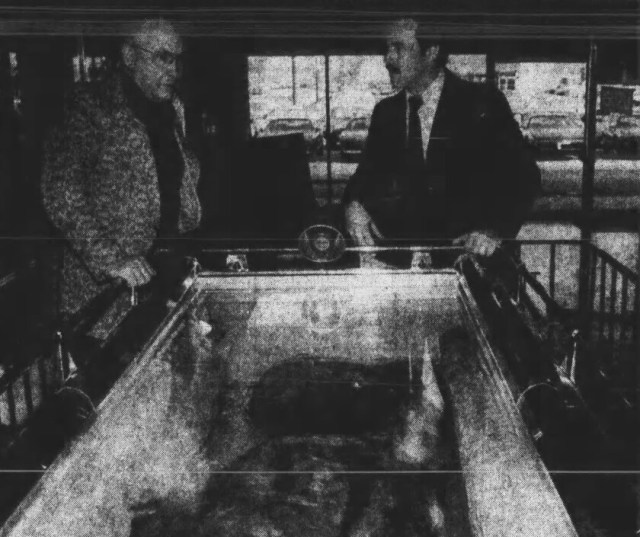
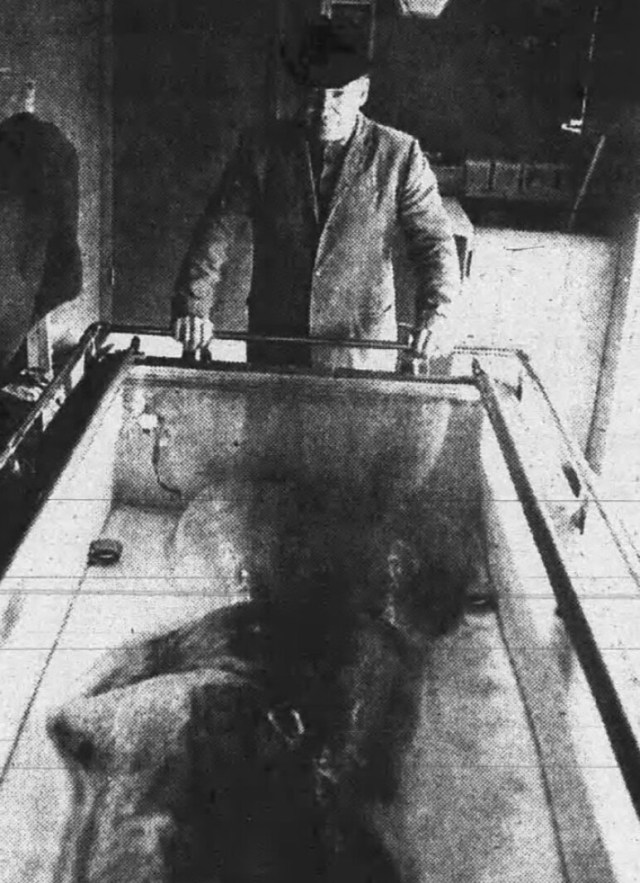
The Iceman was promoted by Frank Hansen, a showman from Rollingstone, Minnesota. Beginning in 1967, Hansen toured state fairs, shopping malls, and carnivals across the United States and Canada, displaying the creature inside a refrigerated trailer.
To the casual observer, the exhibit appeared to be a genuine, grotesque biological specimen. It was described as:
- Physicality: A male, approximately 6 feet (1.8 m) tall, with barrel-chested proportions and long, dark brown hair (3–4 inches long).
- Features: It had large hands and feet, a flattened nose, and a sagittal crest (a ridge of bone atop the skull).
- Trauma: The creature appeared to have suffered significant violence; one arm looked broken, and one eye was hanging from its socket, allegedly due to a bullet that entered the back of the head.
The Investigation (1968–1969)
In December 1968, zoology student Terry Cullen spotted the exhibit in Chicago and alerted two prominent zoologists: American Ivan T. Sanderson and Belgian cryptozoologist Dr. Bernard Heuvelmans.
The two scientists traveled to Hansen’s farm in Minnesota and spent three days examining the creature through the plate-glass lid of the freezer. Despite the ice distortion, they were convinced the body was authentic. They cited the presence of a “smell of decomposing flesh,” the appearance of lice in the hair, and the realistic nature of the wounds as evidence.
Heuvelmans subsequently published a paper in the Bulletin of the Royal Institute of Natural Sciences of Belgium, classifying the creature as a new species he named Homo pongoides (“Apelike Man”). Sanderson wrote an article for Argosy magazine titled, “Is this the missing link between man and the apes?”.
The Web of Origin Stories
Frank Hansen provided conflicting accounts of the creature’s origins, likely to maintain mystery and protect himself from legal scrutiny regarding a potential human cadaver:
- The Bering Sea Theory: Initially, Hansen claimed Russian sealers found the creature floating in a 6,000-pound block of ice off the coast of Siberia; it was then smuggled to Hong Kong before reaching him.
- The Minnesota Hunting Story: In a 1970 Saga magazine feature, Hansen claimed he had shot the creature himself in 1960 while hunting near the Whiteface Reservoir in northern Minnesota, fearing it was a threat to his party.
- The Vietnam Connection: Others speculated the body was a victim of the Vietnam War—possibly a deformed human or primate—smuggled into the U.S. in a body bag.

The Exposure of the Hoax
Scientific and official interest eventually led to the Iceman’s downfall. When the Smithsonian Institution expressed interest in a formal examination, Hansen abruptly withdrew the exhibit, claiming the “absentee owner” (an unnamed California millionaire) had reclaimed it.
Primatologist John Napier, working with the Smithsonian, conducted a preliminary investigation into Hansen’s business and discovered that Hansen had commissioned the creation of a latex model from a West Coast company in 1967. Napier concluded that there was only ever one specimen: a cleverly constructed rubber model that Hansen would periodically “re-pose” or defrost to maintain the illusion of a fresh corpse.
Legacy and Current Status
After years of relative obscurity, the original “Iceman” prop resurfaced on eBay in 2013. It was purchased by Steve Busti, owner of the Museum of the Weird in Austin, Texas, where it remains on public display today as a piece of roadside Americana and a testament to one of cryptozoology’s most elaborate hoaxes.
To read my other blogs on Cryptozoology, click HERE! To read more about the Minnesota Iceman, click on the book covers below.

