Bernard Heuvelmans (1916–2001) was a Belgian-French zoologist, author, and explorer universally regarded as the “Father of Cryptozoology”. Armed with traditional academic credentials, an encyclopedic archive, and a distinct flair for adventure, Heuvelmans transformed the study of hidden, uncataloged animals from sensational folklore into a systematic—if controversial—discipline.

Early Life and Academic Foundations
Born in Le Havre, France, and raised in Belgium, Heuvelmans developed an early obsession with natural history alongside the speculative adventure fiction of Jules Verne and Arthur Conan Doyle. Unlike many later enthusiasts of fringe zoology, Heuvelmans possessed formal scientific training.
He earned his doctorate in zoology from the Free University of Brussels in 1939 at age 23. His dissertation investigated the dentition and classification of the aardvark (Orycteropus afer), establishing his foundation in comparative anatomy. During World War II, Heuvelmans led an eccentric double life in occupied Europe: evading Axis authorities while working as a jazz musician, cabaret singer, and writer. Notably, he served as a science consultant to Hergé, the creator of The Adventures of Tintin, directly influencing the scientifically grounded depiction of the Yeti in Tintin in Tibet.

Codifying Cryptozoology
In 1948, Heuvelmans read an article by Scottish-American naturalist Ivan T. Sanderson titled “There Could Be Dinosaurs,” which discussed the potential survival of prehistoric relics in unexplored biomes. Sanderson’s arguments crystallized Heuvelmans’ growing suspicion that mainstream zoology had prematurely declared the planet fully inventoried.
Heuvelmans systematically formalized the discipline he dubbed cryptozoology—the scientific study of “hidden animals” (cryptids)—creatures known primarily through eyewitness testimony, indigenous oral histories, or indirect physical traces.
His methodology rested on three core arguments:
- Historical Precedent: Science routinely rejected reports of creatures that later proved genuine—such as the mountain gorilla, okapi, giant squid, and coelacanth.
- Ethnozoological Value: Indigenous descriptions and folk traditions often preserve anatomically and ecologically accurate observations that Western taxonomists dismiss as myth.
- Rigorous Filtering: Sightings could be mapped, cataloged, and stripped of cultural exaggeration to reveal consistent anatomical profiles.

Major Works and Classifications
| Work | Published | Scope & Core Arguments |
|---|---|---|
| Sur la Piste des Bêtes Ignorées(On the Track of Unknown Animals) | 1955 (FR) / 1958 (EN) | Foundational text surveying worldwide cryptids, including relict hominids, Asian and African mystery carnivores, and survival of moas. |
| Le Grand Serpent-de-Mer (In the Wake of the Sea-Serpents) | 1965 (FR) / 1968 (EN) | A massive statistical analysis of over 500 maritime reports, categorizing sea serpents into distinct morphotypes. |
| L’Homme de Néanderthal est Toujours Vivant | 1974 | Co-authored with Boris Porchnev; argued for the relic survival of Neanderthals and hominids. |
Heuvelmans’ 1965 sea serpent study remains one of his most ambitious projects. Rather than treating “sea serpents” as a single myth, he sorted hundreds of sightings into distinct biological categories, proposing that most represented undiscovered, specialized mammals:
- Long-necked seals (Megalotaria longicollis): Pinnipeds with elongated necks, accounting for plesiosaur-like sightings.
- Merhorses (Halshippus alaimagni): Deep-diving pinnipeds with mane-like dorsal hair and large eyes.
- Many-humped / Super-otters: Serpentine, elongated archaeocete whales surviving from the Eocene.
- Many-finned (Cetioscolopendra aeliani): Armored cetaceans or segmented marine animals matching the Vietnamese “Con Rit” tradition.

The Minnesota Iceman Controversy
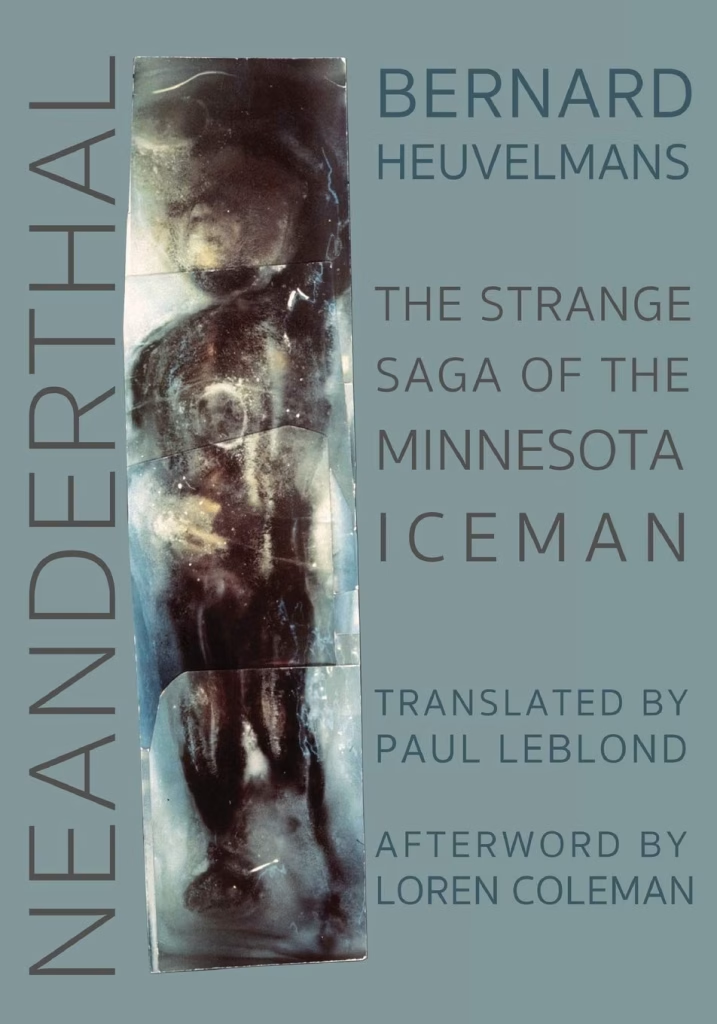
In 1968, Heuvelmans and Sanderson traveled to Minnesota to inspect a carnival attraction: a hairy, ape-like male corpse frozen in a block of ice. After visual examination, Heuvelmans declared it an authentic biological specimen—a living relic hominid he formally dubbed Homo pongoides (“Ape-like Man”).
Heuvelmans pushed for an autopsy and scientific preservation, but the exhibit’s promoter, Frank Hansen, withdrew the original block and substituted a latex replica. The incident severely damaged Heuvelmans’ credibility among mainstream anthropologists, who regarded the entire affair as a sideshow hoax.

Legacy and The International Society of Cryptozoology
Despite skepticism from orthodox academia, Heuvelmans remained committed to rigorous inquiry. In 1982, he helped establish the International Society of Cryptozoology (ISC) at the Smithsonian Institution, serving as its inaugural president. The society aimed to elevate the field by enforcing peer review and zoological standards, publishing its journal Cryptozoology through the 1990s.
Heuvelmans passed away in Le Vésinet, France, in August 2001 at age 84. Before his death, he bequeathed his private archive—comprising over 50,000 documents, photographic files, and field notes—to the Museum of Zoology in Lausanne, Switzerland, where it remains the premier research archive for cryptozoological history.
To read other entries in my Basement’s World of the Weird series, click HERE! To read books by Bernard Heuvelmans, click on the book covers below.