

The Fouke Monster—often called the Boggy Creek Monster—is one of North America’s most enduring regional cryptids. Rooted in the dense cypress swamps, backwaters, and pine flatwoods surrounding the small town of Fouke in Miller County, Arkansas, the creature transformed from localized folklore into a nationwide pop-culture phenomenon during the 1970s.

Physical Anatomy and Behavior
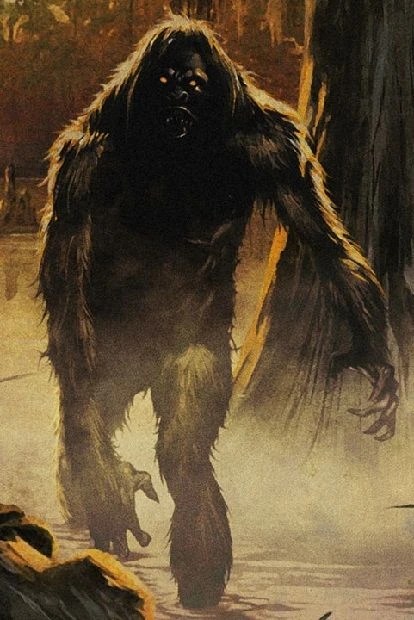
Eyewitness accounts across southwest Arkansas describe a creature sharing traits with both the Pacific Northwest Sasquatch and the southern Skunk Ape:
- Stature and Build: Estimated between 7 and 8 feet (2.1–2.4 m) tall, weighing roughly 300 to 400 pounds, with broad shoulders and an upright, human-like bipedal gait.
- Coat: Thick, dark brown or black hair covering the entire body, occasionally noted as matted with river mud or burrs.
- Footprints: Unlike classic Sasquatch tracks, Fouke prints frequently featured three distinct toes—a detail that puzzled researchers, though five-toed tracks were also occasionally found.
- Scent and Sound: Encounters were consistently preceded by a foul, sulfuric or decaying odor and punctuated by piercing, high-pitched vocalizations described as a cross between a wolf’s howl and a human scream.
The 1971 Ford Incident
While regional sightings stretch back to the 1940s, the incident that catapulted the creature to state and national attention occurred on the night of May 1, 1971, at the rural home of Bobby and Elizabeth Ford.
Around midnight, Elizabeth reported a hairy arm reaching through a window screen. Her husband Bobby and his brother Don returned shortly after and engaged what they described as a large, ape-like figure prowling outside the house. Bobby fired a shotgun at the intruder, but the creature reportedly charged, knocking him to the ground before retreating into the surrounding timber.
Bobby Ford was treated at St. Michael’s Hospital in nearby Texarkana for scratches and shock. Investigating officers, led by Miller County Sheriff Leslie Greer, recovered physical claw marks on the home and plaster casts of three-toed footprints measuring nearly 14 inches in length.

Pop Culture: The Legend of Boggy Creek
In 1972, indie filmmaker Charles B. Pierce leveraged the local accounts to produce The Legend of Boggy Creek. Shot on a meager budget of around $160,000, the film pioneered the faux-documentary docudrama style later popularized by found-footage horror.
Pierce cast real Fouke residents—including Willie E. Smith and Travis Crabtree—to recount their own experiences and reenact sightings. Driven by atmospheric shots of the Sulphur River bottoms and eerie narration, the film grossed over $20 million, embedding the Fouke Monster into American monster lore alongside Bigfoot and Mothman.
Theories and Explanations
| Perspective | Core Hypothesis | Key Arguments |
|---|---|---|
| Cryptozoology | Undiscovered hominid or relict primate | Dense, remote river bottomland provides ample cover, food, and contiguous habitat into Texas and Louisiana. |
| Zoological Misidentification | Native black bear (Ursus americanus) | Bears standing or running upright on rear legs, particularly those afflicted with mange or seen under poor nighttime lighting, closely resemble hairy bipedal figures. |
| Hoaxing & Mythmaking | Practical jokes amplified by media hysteria | The discovery of three-toed tracks matches human manufacture rather than standard primate morphology; local hunting culture encouraged pranks. |
Today, Fouke embraces its swamp-dwelling celebrity. The town features themed roadside attractions, including the “Monster Mart,” where travelers on U.S. Highway 71 stop for Boggy Creek merchandise, preserving a slice of classic American folklore.
To read my other Cryptozoology blogs, click HERE!