Tucked away in the Chequerfield housing estate of Pontefract, West Yorkshire, 30 East Drive looks like any ordinary mid-century semi-detached council house. Yet between 1966 and the late 1970s, this modest brick residence became the epicenter of one of the most violent and documented poltergeist cases in European history: the entity known locally as “Fred,” and later, the Black Monk of Pontefract.

The Arrival and Initial Disturbances (1966)
In August 1966, Joe Pritchard, an engineer, moved into No. 30 with his wife Jean, their fifteen-year-old son Phillip, and twelve-year-old daughter Diane. The house was newly built by the local council, ruling out immediate suspicions of decaying architecture or ancient, unmaintained plumbing.
The disturbances began almost immediately during a bank holiday weekend while Joe and Jean were away, leaving Phillip home with his grandmother, Sarah Scholes.
- The Powder Falls: Fine white dust—later tested and identified as powdered builder’s chalk—began sifting down from ceilings across multiple rooms without any structural breaches.
- Spontaneous Pools: Puddles of clean water repeatedly formed on kitchen counters, linoleum, and carpets within seconds of being dried.
- Apparatus Movement: Heavy oak furniture shifted across rooms, kitchen cabinets banged open, and light switches toggled rhythmically in broad daylight.
The family initially attempted to rationalize the disruptions, nicknaming the unseen presence “Fred.” However, the lighthearted domestic mystery quickly dissolved as the activity intensified.

Escalation into Physical Violence
Unlike traditional poltergeist disturbances that confine themselves to auditory knocks and displaced cups, the force at 30 East Drive escalated into overt physical aggression. The phenomena centered disproportionately on the family’s youngest daughter, Diane, fitting a classic parapsychological profile of adolescent-focused poltergeist energy, though with far greater physical consequence.
- Assault on Diane: Diane was repeatedly thrown from her bed during the night. In the most infamous incident—witnessed by her parents—she was dragged kicking and screaming up the staircase by an unseen grip around her neck. Afterward, deep, dark bruises resembling handprints and finger marks remained imprinted across her throat.
- Thermal Anomalies: Entire rooms dropped precipitously to freezing temperatures within moments, leaving occupants’ breath visible in the middle of summer.
- Desecration and Destruction: Family portraits were repeatedly slashed with kitchen implements, rosaries and crucifixes were systematically broken or melted, and heavy mirrors shattered outward rather than inward.
- Apparitions: Rather than subtle shadows, several witnesses reported seeing a towering, featureless silhouette wearing the black, flowing hooded robes of an ancient monastic order floating above beds or lingering on the upper landing.

Historical Lore: The Cluniac Priory and Gallows Hill
Seeking explanations beyond conventional domestic hauntings, local historians and independent investigators delved into the topography of Pontefract.
Local researcher Tom Cuniff uncovered that the Chequerfield estate had been constructed over terrain directly adjacent to an ancient gallows hill, along with land historically tied to the medieval Pontefract Priory—a Cluniac monastery founded in the 11th century.
According to local records and regional folklore, a 16th-century Cluniac monk had been convicted of the assault and murder of a local girl and subsequently hanged at the nearby gallows during the reign of Henry VIII. This historical account quickly cemented the entity’s moniker as the “Black Monk,” connecting the physical assaults on young Diane to the alleged crimes of the historical figure.

Documented Investigations
The case attracted substantial attention from local authorities and paranormal researchers alike:
- Police and Clergy Involvement: Local constables summoned to the home reported witnessing heavy wardrobes toppling over on their own and objects flying across hallways. A local vicar was brought in to perform a minor exorcism; witnesses claimed holy water thrown onto surfaces hissed, boiled, and was promptly thrown back across the room by an unseen force.
- Colin Wilson’s Account: Renowned British philosopher and writer Colin Wilson examined the case extensively for his seminal 1981 work, Poltergeist! A Study in Destructive Haunting, citing 30 East Drive as one of the rare cases where physical violence and macro-PK (psychokinesis) occurred in front of skeptical third-party witnesses.
Cultural Legacy and Modern Status
The violent activity gradually waned toward the late 1970s as Diane reached adulthood and moved out, leaving the house relatively quiet for several decades.
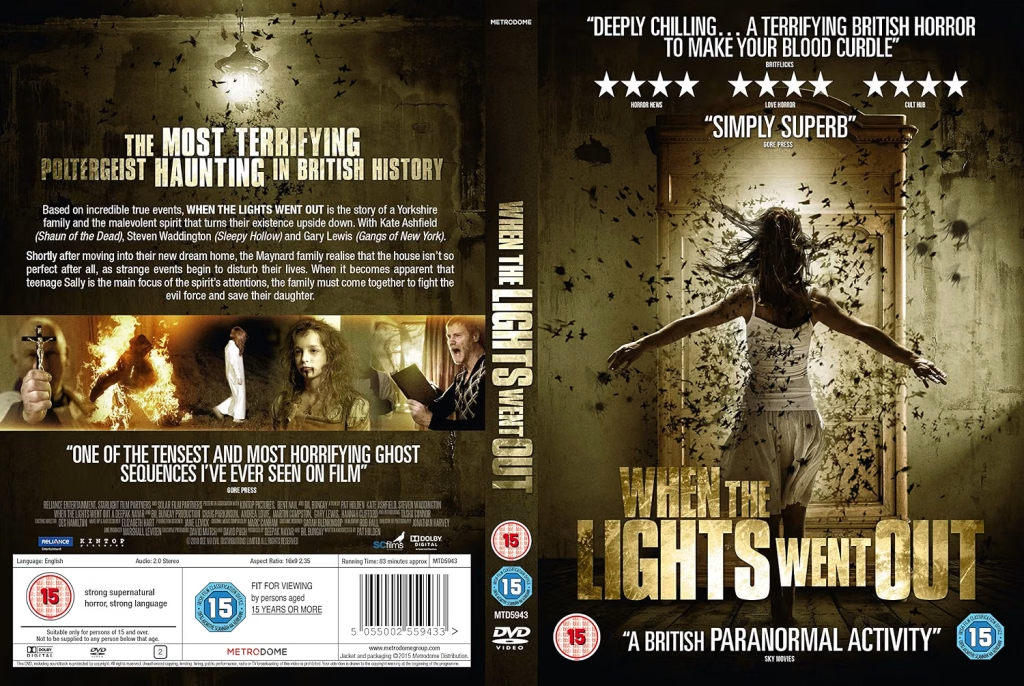
Interest was reignited in 2012 with the release of the British horror film When the Lights Went Out, directed by Pat Holden—the real-life nephew of Jean Pritchard—who based the script on his family’s personal experiences in the house. Following the film’s production, film producer Bil Bungay purchased 30 East Drive. Bungay preserved the property’s authentic 1970s interior decor, wallpaper, and furnishings.
Today, 30 East Drive functions as a private location for booked overnight paranormal investigations, continuing to produce reports of temperature drops, moving objects, and disembodied footsteps on the upper landing.
To read other blogs in my Paranormal category, click HERE! To see the film When the Lights Went Out, click on the DVD cover below.