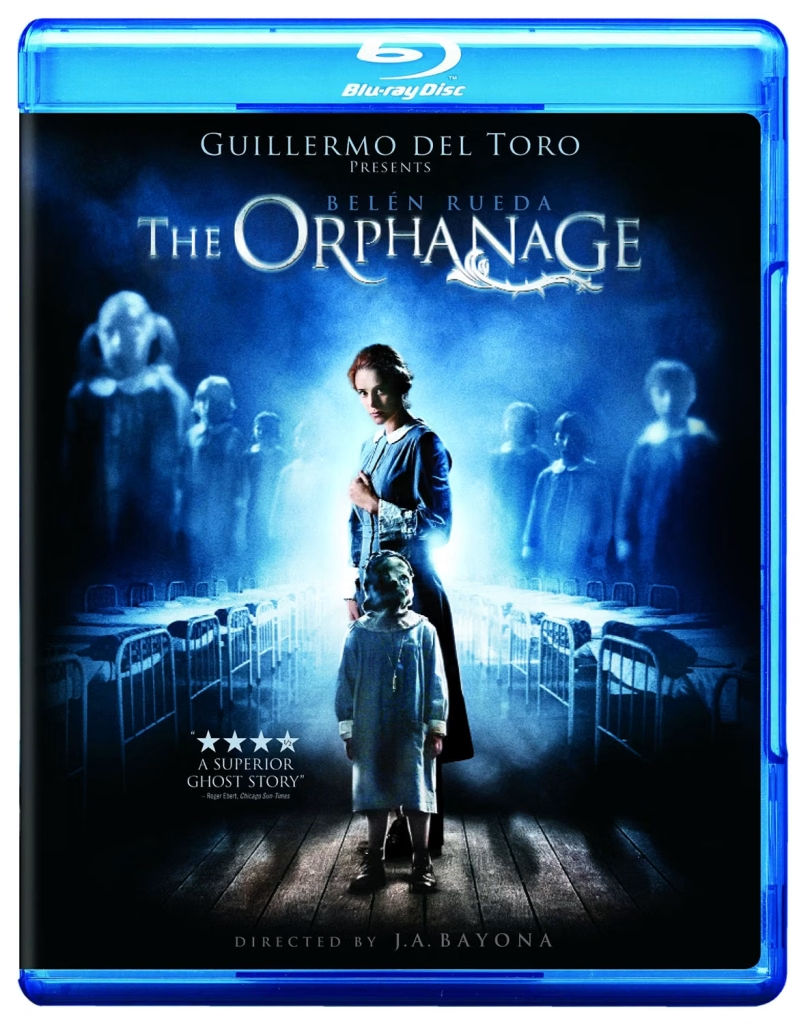
Directed by J.A. Bayona in his feature directorial debut and produced under the wing of Guillermo del Toro, The Orphanage (El Orfanato, 2007) stands as one of modern horror’s most poignant achievements. Written by Sergio G. Sánchez, the film eschews gratuitous gore and cheap jump scares, instead constructing an atmospheric, classical ghost story where terror is rooted entirely in maternal grief and tragedy.

Core Narrative and Premise
The story follows Laura (Belén Rueda), a woman who returns with her physician husband Carlos (Fernando Cayo) and adopted son Simón (Roger Príncep) to the coastal Spanish manor where she spent part of her childhood as an orphan. Her dream is to reopen the grand estate as a home for children with disabilities.
Complications arise rapidly:
- The Invisible Friends: Simón begins conversing with invisible playmates, notably an entity named Tomás who wears a stitched burlap sack over his head.
- The Disappearance: During an opening-day party, following an argument between Laura and Simón over his adoption and illness, Simón vanishes without a trace.
- The Investigation: As months pass and police searches yield nothing, Laura encounters remnants of the manor’s dark past—uncovering the murder of several orphans decades prior by a vengeful former staff worker, Benigna (Montserrat Carulla).

Themes and Cinematic Craft
Rather than relying on monstrous antagonists, The Orphanage functions primarily as a psychological meditation on loss, trauma, and maternal devotion.
- Fairy Tales and Neverland: The narrative regularly invokes J.M. Barrie’s Peter Pan, a story Laura reads to Simón. The orphans represent the “Lost Boys”—children frozen in time who never grow up—transforming the haunting into an allegory for arrested development and premature death.
- Gothic Atmosphere and Restraint: Cinematographer Óscar Faura captures the Asturian coast and the cavernous Partarríu mansion with sweeping, shadowed compositions. Bayona relies on subtle practical cues—creaking floorboards, locked doors, and children’s parlor games like “Un, dos, tres, toca la pared” (Red Light, Green Light)—to generate suffocating dread.
- Belén Rueda’s Central Performance: Rueda carries the film’s emotional core, seamlessly oscillating between rational desperation, paralyzing terror, and unconditional devotion.

The Climactic Revelation
(Major spoilers ahead)
Laura eventually surrenders entirely to the supernatural logic of the house, staging the rooms and playing the children’s games to coax out the spirits. The resolution is famously heart-wrenching: the haunting was never malicious.
On the day Simón vanished, Laura had unwittingly locked him inside a hidden basement room while barricading a door beneath the stairs with scaffolding. Simón fell trying to escape in the dark and died of a broken neck. The unexplained thumps Laura heard throughout the months were not ghosts, but her son desperately banging on the underside of the floorboards. In the devastating finale, Laura takes an overdose of pills to cross over and remain forever as the caretaker of Simón and the forgotten orphans.

Critical Reception and Legacy
Debuting to a ten-minute standing ovation at the 2007 Cannes Film Festival, The Orphanage swept Spanish cinema:
| Category | Achievement |
|---|---|
| Goya Awards | 14 nominations, 7 wins (including Best New Director, Original Screenplay) |
| Box Office | Over $78 million worldwide against a modest ~€4 million budget |
| Critical Status | 87% on Rotten Tomatoes; widely cited alongside The Others and The Devil’s Backbone |
By anchoring its supernatural chills in raw domestic tragedy, The Orphanage established Bayona as an elite visual stylist and remains a masterclass in gothic, emotionally driven horror.
To read the rest of my Monstrous Movie Reviews, click HERE! To add this movie to your film collection, click on the Blu-ray cover below.